
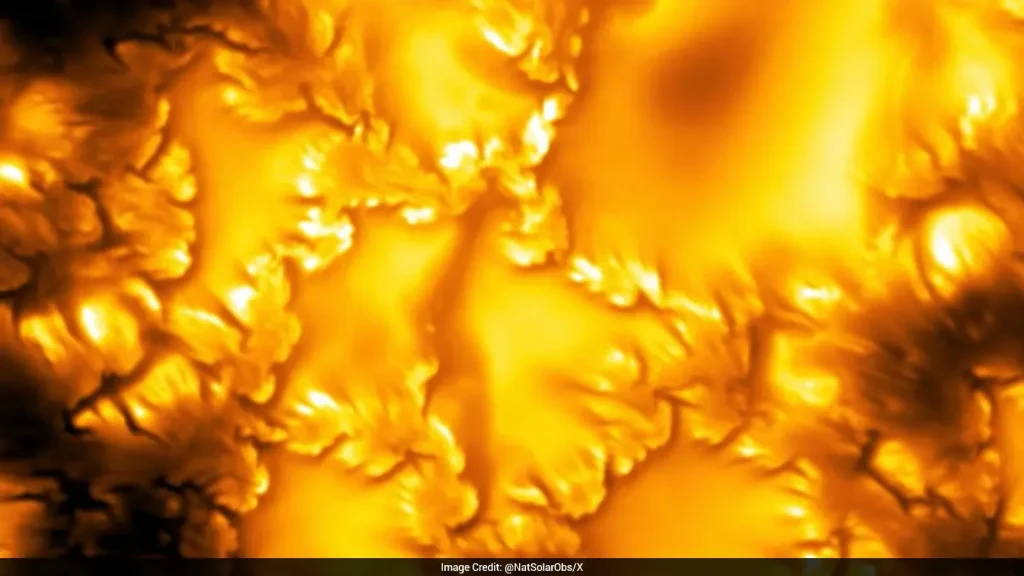
Recent observations have provided an unprecedented view of the Sun’s visible surface, revealing intricate swirling patterns associated with its magnetic fields and energy. These findings could enhance our understanding of solar activity and its development, as reported by CNN.
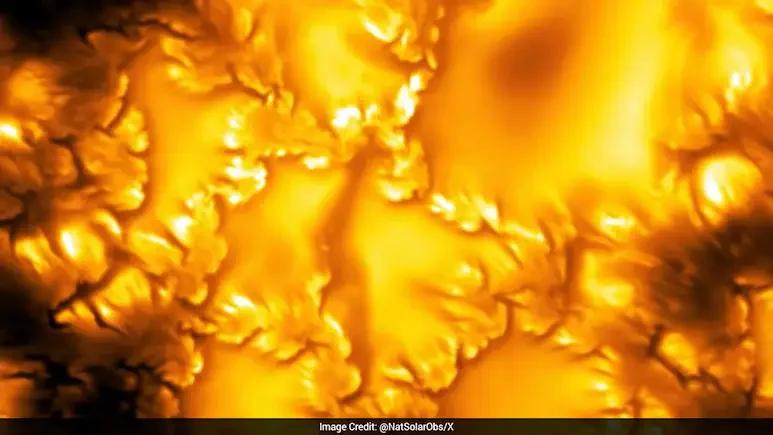
Scientists used the National Science Foundation’s Daniel K Inouye Solar Telescope, located near the summit of Haleakala on the Hawaiian island of Maui, to observe a magnetically active area near a sunspot. Sunspots are considered hotspots of solar activity. The swirling patterns are known as Kelvin-Helmholtz instability. Kelvin-Helmholtz instability occurs when two fluids moving at different speeds pass one another. Scientists have observed this type of instability in lake and ocean waves, cloud formation, and the atmospheres of large gaseous planets such as Jupiter and Saturn. The tension eventually becomes unstable, causing the tangled magnetic fields to snap apart and reconnect, releasing a burst of energy.
The researchers said the phenomenon could help explain some long-standing mysteries about the Sun. This creates small disturbances that develop into spiraling vortices, according to the study. Scientists have long believed that the Sun stores magnetic energy through a process called “flux braiding”, in which magnetic field lines twist together.
