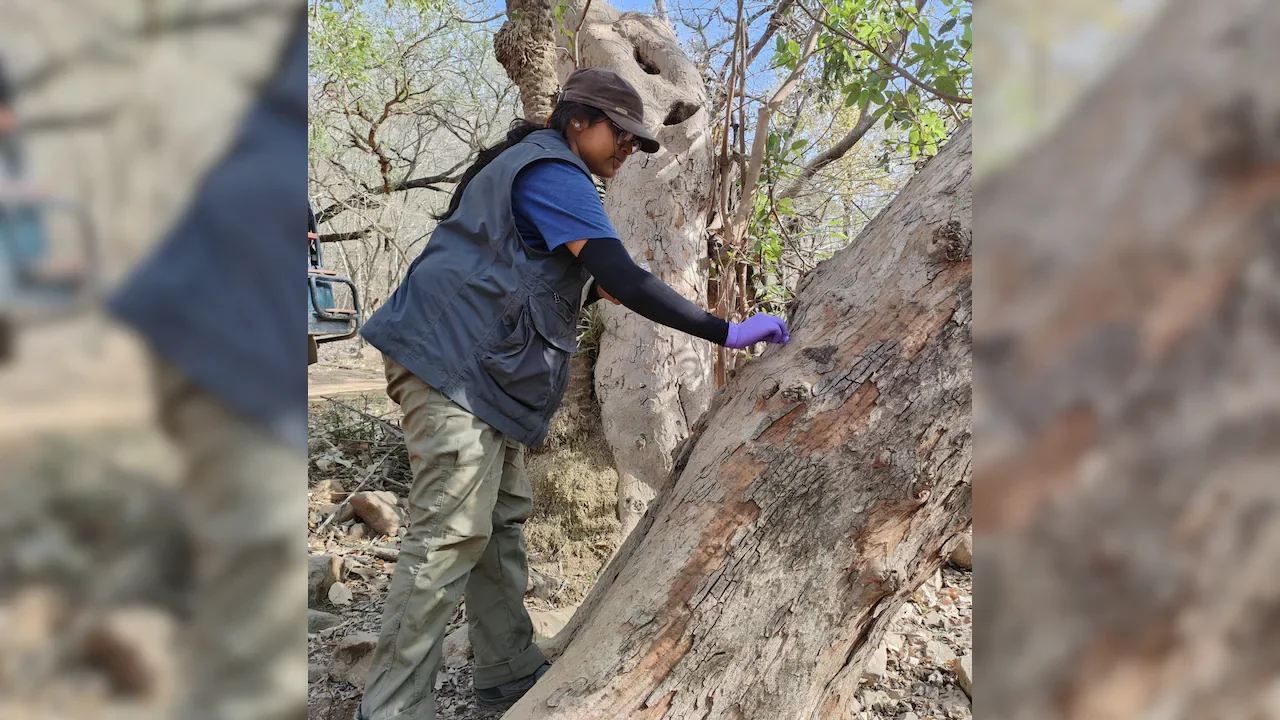
Tigers and leopards rarely announce themselves in forest. They move silently through dense vegetation, often avoiding human contact for years. Yet these elusive predators constantly leave behind messages for one another. Every spray of urine on a tree trunk and every scat deposited along a forest trail carries a chemical signature that tells a story about that animal.
It combines cutting edge analytical chemistry with wildlife conservation and opens up a new frontier in animal monitoring known as volatilomics, the study of volatile organic compounds released by living organisms. Now, researchers from the National Centre for Biological Sciences (NCBS), part of the Tata Institute of Fundamental Research under the Department of Atomic Energy, have developed a novel way to read those messages. Using advanced chemical ecology techniques, they have shown that the scent compounds present in tiger and leopard urine and scat can reveal the species, age, sex and even reproductive status of the animal. The breakthrough offers wildlife managers a powerful new non-invasive tool to monitor India’s two most iconic big cats. The study, recently published in the Journal of Chemical Ecology, represents the first successful sampling of scent signatures from individually identified wild tigers. The research was supported by a grant from the National Geographic Society. The research team wanted to know if modern analytical instruments and machine learning algorithms could decode the same information hidden within these odours. Using ultra-sensitive thermal desorption gas chromatography mass spectrometry, they analysed hundreds of samples and identified several chemical compounds that reliably distinguished tigers from leopards. They also discovered chemical combinations that could indicate whether an animal was male or female and whether it was young or old. The transformation came with camera trapping and statistical capture-recapture techniques. Motion triggered cameras provided photographic evidence of individual animals, whose stripe patterns serve as unique identifiers. Combined with habitat surveys and occupancy modelling, India developed one of the world’s most sophisticated wildlife census systems. The results have been dramatic. Yet even modern camera trap surveys have limitations. Cameras can identify individuals but often struggle to accurately assess age, health, reproductive condition or physiological status. This is where chemical ecology may add an important new layer of information. By combining camera trap images, DNA fingerprinting from scat samples and chemical signatures from urine and faeces, wildlife biologists could potentially build a far richer picture of a tiger population than any single technique can provide. The study provided an intriguing glimpse of this possibility. During the research, the scientists sampled a captive tiger undergoing treatment for epilepsy. The animal’s scat showed elevated levels of dimethyl tetrasulphide. it suggests that scent chemistry may someday offer clues about disease and health complications While the observation came from only a single animal and is far from conclusive. For Prof Uma Ramakrishnan, one of India’s most respected wildlife geneticists and a senior author of the study, the significance extends beyond tigers and leopards. The implications stretch far beyond India’s forests. The sampling method developed at NCBS is inexpensive, non-invasive and adaptable to other species. Similar approaches could eventually be used for wolves, bears, wild dogs, snow leopards and many other threatened mammals.
India’s tiger population, which stood at 1,411 in the 2006 All India Tiger Estimation, increased to 1,706 in 2010, 2,226 in 2014, 2,967 in 2018 and 3,167 in 2022 according to official national tiger assessments. These advances have helped establish India as the global stronghold for tigers despite have a burgeoning human population now reaching nearly 1.4 billion people.