
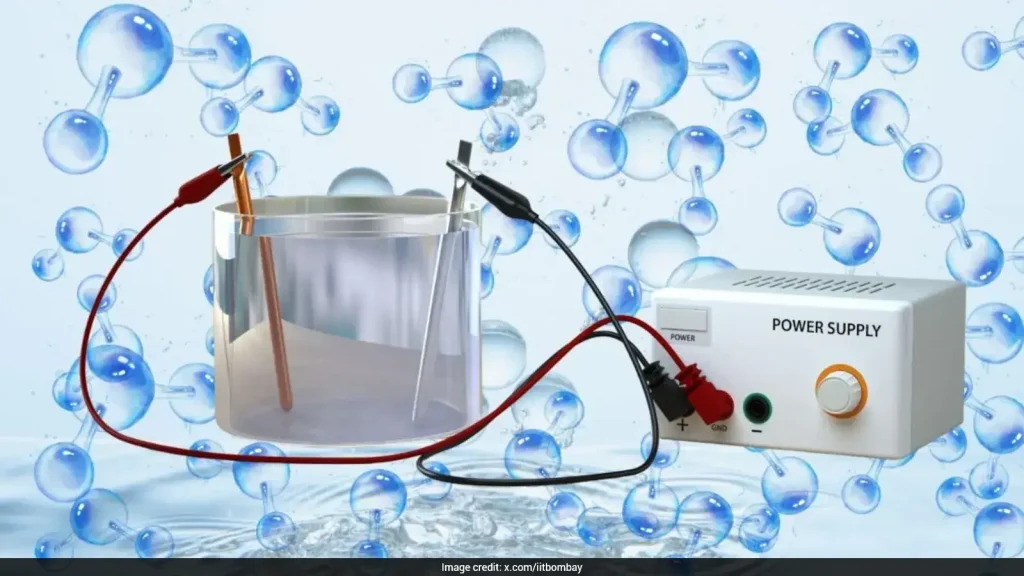
IIT Bombay: In a breakthrough, researchers at the Indian Institute of Technology (IIT) Bombay have developed a highly efficient, low-cost catalyst that can significantly improve the production of green hydrogen. The institute stated that the team has created a novel material combining cobalt, nickel, phosphate, and graphite that efficiently produces hydrogen and oxygen gas from water.
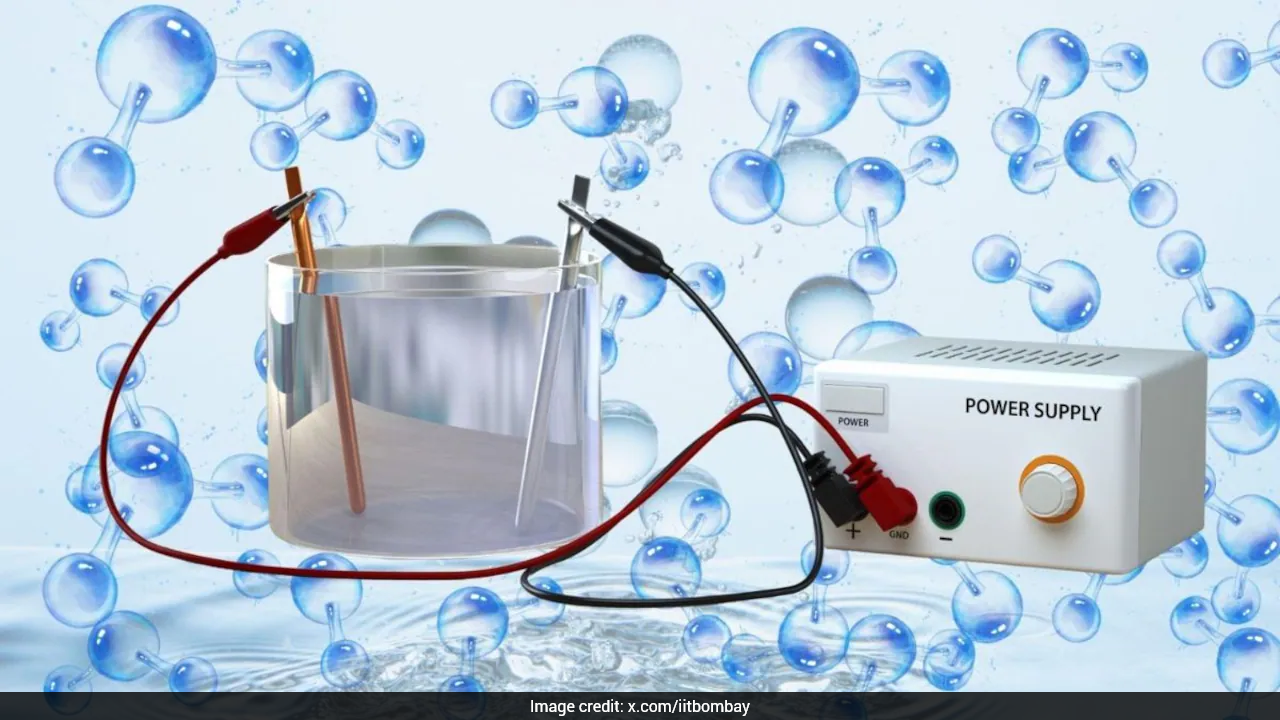
The report highlighted that one of the simplest ways to split the water molecule is by electrolysis, in which an electrical current is passed through water to separate it into hydrogen and oxygen. This process, however, faces significant kinetic barriers, requiring substantial energy to get started, the team stated. Explaining the research, Dr Savi Chaudhary, a researcher at IIT Bombay and the first author of the study stated that “the primary motivation was to develop an efficient and durable earth-abundant catalyst for overall water splitting. To fabricate the new catalyst, the researchers turned to molecular precursor engineering, a technique that involves designing highly specific molecules and metallic compounds that serve as building blocks or precursors for more complex materials. The amorphous nature of this material means its atoms are arranged randomly instead of being neatly arranged as in a crystal, the team stated. This also enhances its performance, as its disordered structure creates a larger surface area that serves as ideal docking sites for both hydrogen evolution reaction (HER) and oxygen evolution reaction (OER), as per the report. The institute stated that the development of this robust, earth-abundant catalyst can help power a sustainable energy future. By eliminating the reliance on expensive noble metals and proving that affordable, highly active materials can be engineered in the lab, the research brings the world one step closer to producing cheap, zero-emission hydrogen fuel for powering our homes, vehicles, and industries, the team noted.
This approach “is advantageous because it allows precise control over the composition and homogeneity of the resulting material, while enabling its conversion into the active catalyst under relatively mild conditions, according to Dr Chaudhary.
