
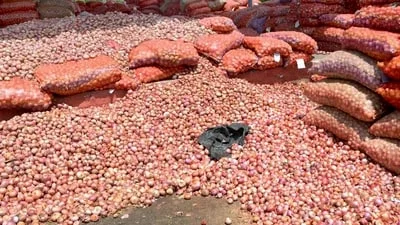
The government has announced a rise in the Minimum Assured Procurement Price (MAPP) for onions to ₹ 26.45 per kg, marking the seventh increase this year. This decision comes as tighter supplies and delayed arrivals have driven wholesale prices higher. Analysts predict that onion prices will remain stable in the near future due to these supply constraints.
The latest increase takes the procurement price to more than double the level at which government procurement began in mid-May. Government procurement accelerated after a slow start. The MAPP has risen from around ₹ 12.70 per kg to ₹ 26.45 per kg as of August 18, an increase of about 108%. While the government was able to achieve only around 2% of the 200,000-tonne procurement target by end-June, its buys ramped up to around 55% or 110,000 tonnes by July end as it relaxed procurement specifications.
However, with relaxations in procurement specifications taken back and reverted to procuring Grade-A onions government procurement pace could moderate, Sharma said, particularly given concerns over the quality of available rabi stocks. As per Singh, traders are also closely tracking government stocks which continue to be lower than the target which he said is prompting some hoarding. “Traders see the government as having low stocks, so hoarding has begun,” he said.
Meanwhile, the southern crop that normally bridges this gap is also weak. To add to that, the supply pressure is being compounded by delays in the next crop as the kharif onion, that comes in by October, is likely to be delayed due to a delayed monsoon this year.
Prices are likely to continue climbing and peak towards September and October, when stored rabi onions are expected to run down and fresh kharif arrivals are likely to be delayed, according to experts. “The Nashik onion which comes from October onwards is unlikely to come for another month,” said Vikas Singh, vice-president of the Horticulture Produce Exporters Association. “Backup supplies used to come from Karnataka and Andhra Pradesh, particularly South Bellary, but with low and delayed rainfall, the crop is delayed and lower this year,” Singh said.
