
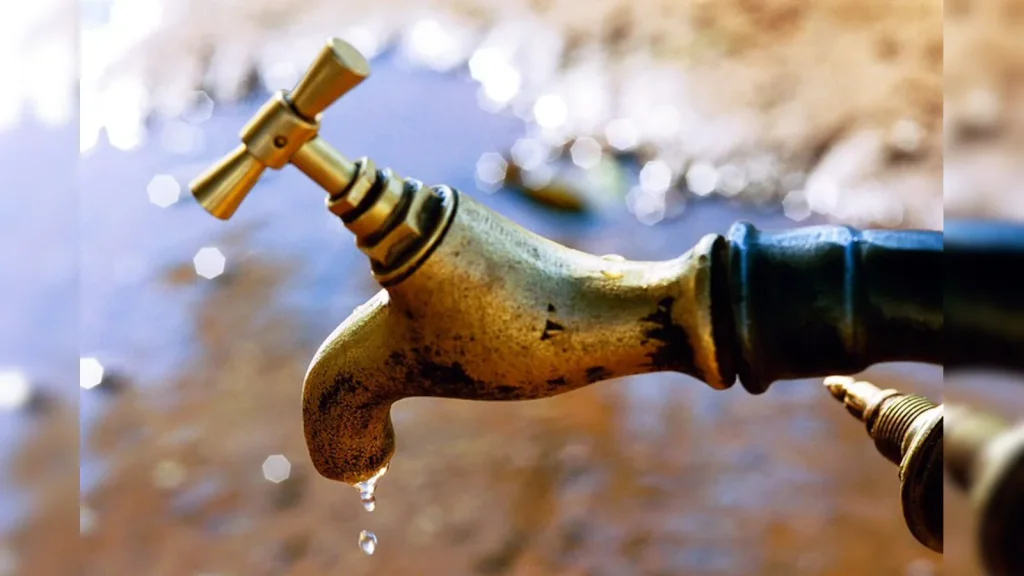
Madhya Pradesh’s water story is no longer just about dry wells, defunct handpumps, and women walking kilometres with pots of water balanced on their heads. Pipes have now been laid across villages, overhead tanks have come up, and taps have been installed. In government files, the Jal Jeevan Mission continues to make progress. But the fundamental question remains: is water actually reaching those taps? Images and reports emerging from different parts of Madhya Pradesh make that question increasingly difficult to ignore. In some places, there is a tap but no water. Elsewhere, water comes but not regularly. And even where water reaches households, there are questions over whether it is safe to drink.
This is not the finding of a private survey. A villager, identified as Bajrangi, tied copies of his old applications to his body and crawled to the divisional commissioner’s office to draw attention to the village’s water problem. He alleged that despite approaching officials from the collector to ministers and the chief minister, the problem had not been resolved.
Twenty-three of Madhya Pradesh’s 55 districts have been assessed as having less than 70 per cent coverage of potable tap water. In other words, nearly 42 per cent of the state’s districts are on a list where even seven out of every 10 households have not been covered by household tap connections. About 40 kilometres from Bhopal, the desperation over water took an extraordinary form in Bishankhedi village of Sehore district in April 2025. Of the 20 handpumps serving the village with a population of around 2,100, only 12 were reported to be functional at the time.
The administration did not agree with all his allegations, but the Public Health Engineering Department acknowledged a shortage of water around the village community hall and said an alternative borewell had been arranged.
The government has also explained why these districts are lagging. Several of these schemes are still at different stages of implementation and completion. However, the same assessment also pointed to the need for improvement in quantity, supply, and quality of drinking water. The infrastructure for testing water quality raises another important question. Biological Oxygen Demand can be tested at the state-level laboratory, but the Parliamentary response clearly states that the facility for testing chemical toxicity is not available. It is also about how many of those taps actually receive water, how regularly they receive it, and whether the water coming out of them is safe to drink.
The question in Madhya Pradesh, therefore, is no longer simply how many households have been given taps. The latest functionality assessment under the Jal Jeevan Mission indicated that functional household tap water connections were working in 77.21 per cent of households in Madhya Pradesh, according to the government. The government told the Rajya Sabha that Madhya Pradesh has 155 water quality testing laboratories, including 103 at the sub-divisional level, 51 at the district level and one at the state level. In January 2026, NDTV reported, citing the Jal Jeevan Mission’s Functionality Assessment Report, that only 63.3 per cent of water samples tested in rural Madhya Pradesh passed quality tests, compared with a national average of 76 per cent. The report also said that while 99.1 per cent of villages in the state had piped water supply systems, taps were found to be functional in only 76.6 per cent of households.
The primary reason for the low coverage is that these districts are largely dependent on multi-village schemes and other remaining water supply projects, according to information furnished by Madhya Pradesh’s Public Health Engineering Department. The administration subsequently said the expenditure would be investigated.
