
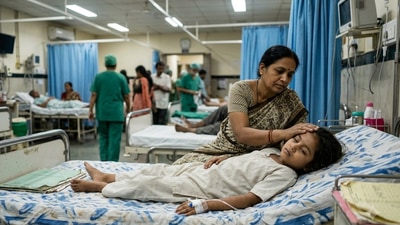
Amid rising H1N1 (swine flu) cases in the city, Delhi health minister will hold a meeting with municipal health officers (MHO) and officials of all government hospitals on Monday to assess the situation, officials aware of the matter said on Sunday.
Health minister Pankaj Singh has also issued directions to chief district medical officers, district surveillance officers and hospitals on the screening, reporting, and monitoring of influenza-like illness (ILI) and severe acute respiratory infections (SARI) cases. I can assure that there is no need to panic at all. “Swine flu and H3N2 can present with overlapping symptoms in the early days, so testing is key rather than guessing or self-medicating.
Because patients are reaching us in time,” he said, we are seeing good recovery rates. Delhi has recorded more than 3,000 H1N1 cases in three recent outbreak years – 4,307 cases in 2015, 3,627 in 2019 and 3,151 in 2024, according to National Centre for Disease Control (NCDC) data. This year’s tally of nearly 1,777 cases remains well below those peaks.
Speaking to HT, Singh said, “There is a definite rise in cases and several patients are presenting with high-graded fever, but…we have not received any reports yet of patients needing ICU or ventilator cases. Dr Neetu Jain, senior consultant, pulmonary, critical care and sleep medicine at PSRI Hospital, said, “High humidity and temperatures can contribute to the spread of influenza and other viral infections” Low uptake of the low uptake of influenza vaccination and the fact that “there have been fewer significant flu outbreaks in the last two to three years, which means many people may not have had recent exposure to influenza viruses” may be other factors contributing to the uptick in cases, Jain said. Dr Sunil Rana, associate director and Head, Internal Medicine (Unit III), Asian Hospital, said more patients are seeking testing soon after symptoms begin rather than waiting for the illness to resolve on its own.
