
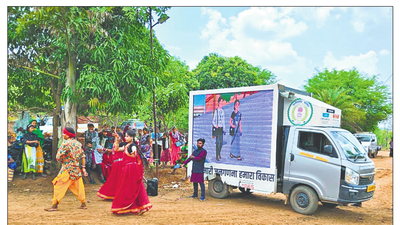
This year, government teams will conduct a census in at least 103 villages in the Bastar division of Chhattisgarh, which were inaccessible during the 2011 Census due to Maoist insurgency. This marks the first time in decades that officials have gained access to these remote settlements, allowing for a comprehensive count of the population in these areas.
Some of these villages still have no motorable roads. Officials have reached them on foot and motorcycles, walking for miles, crossing streams and trekking through forests. The PVTGs (particularly vulnerable tribal groups), especially in Abujhmad, were not in government records. The existing schemes are based on old data. Getting them covered under the Census will help the government plan development schemes. “The locals should also be comfortable sharing details with the government representatives, many of whom they are meeting for the first time. They have since collected administrative data on the villages and their residents. “Every enumerator is being trained in the local dialect. “Many villages within Abujhmad and Orchha block will find their names in the census records for the first time. The people who lived there rarely appeared in government records.
Because of the Maoist insurgency in 2011, bastar resident Anubhav Shori, a youth leader and district coordinator of ATREE (Ashoka Trust for Research in Ecology and the Environment), said, “Large parts of indigenous people were left out. Villages such as Ghamandi, Pangud and Jatwar were surveyed earlier this year after government teams began entering the remotest areas in late 2025, according to census department and district officials. Since 2011 there have been demographic changes in the region. The number of people who were not counted in 2011 cannot yet be established, officials said. Narayanpur district, which contains the largest part of Abujhmad, had a population of 139,820 in the 2011 Census, but the remotest villages were not covered. Government teams began entering these areas after October-November 2025, according to district officials. Kartikeya Sharma, director of Census Operations and Citizen Registration for Chhattisgarh, said the first phase of Census 2027, the house-listing and housing census, had accounted for the households missed during the 2011 exercise.
Our enumerators also visited the houses deep inside for the house listing operation,” she said. Classes and training sessions are also being conducted to help our citizens understand the Census and the benefits of them being recorded in government records,” Jain said. Abujhmad, loosely translated as the unknown hills, was an area once marked as unknown on the map, but now every household is finally being known and every person will be counted,” she said.
Mobile App Data Collection Achieves High Coverage in Bastar
In Bastar, a recent mobile app-based data collection initiative successfully covered over 98% of the expected households, according to Sharma. This significant achievement highlights the effectiveness of technology in reaching local communities and gathering essential data.
