
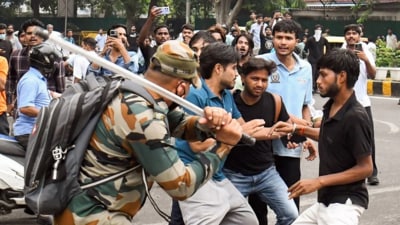
On Monday, the Supreme Court clarified that it will not initiate separate proceedings regarding allegations of sexual assault against women protesters during the student protests on July 20 in New Delhi. Instead, the court stated that these allegations are being addressed by a five-member committee led by former judge R Subhash Reddy, which has already prioritized the issue.
Gupta submitted that there were widely reported allegations of women being molested and sexually assaulted by police personnel and sought a separate mechanism for investigating the complaints. The bench pointed out that the committee chairperson had been empowered to appoint nodal officers, following which the procedure for submitting complaints would be notified. Other members of the committee include Justice (retired) Ravi Shankar Jha, former chief justice of the Punjab and Haryana high court, Justice (retired) Shalinder Kaur, former Delhi high court judge, Rishi Kumar Shukla, former Central Bureau of Investigation director, and LR Bishnoi, retired director general of police, Meghalaya. Its mandate extends beyond the immediate allegations of police violence. The committee has also been asked to examine allegations of violence by protesters against police personnel, damage to public property and injuries suffered by security personnel. On the allegations concerning women protesters, the court specifically directed the panel to examine incidents of targeted violence besides assessing medical and other support provided to victims and the possibility of interim compensation.
The HPEC was constituted to conduct an independent and impartial inquiry into competing allegations arising from the July 20 student protest—petitions alleging excessive force by police as well as pleas concerning violence against police personnel and legality of the protest. The committee has been asked to examine the use of pellet guns, electric batons, lathis and tear gas, the proportionality of police action, the use of blanket prohibitory orders, surveillance of protesters and the invocation of Section 152 of the Bharatiya Nyaya Sanhita, which criminalises acts endangering the sovereignty, unity and integrity of India.
