
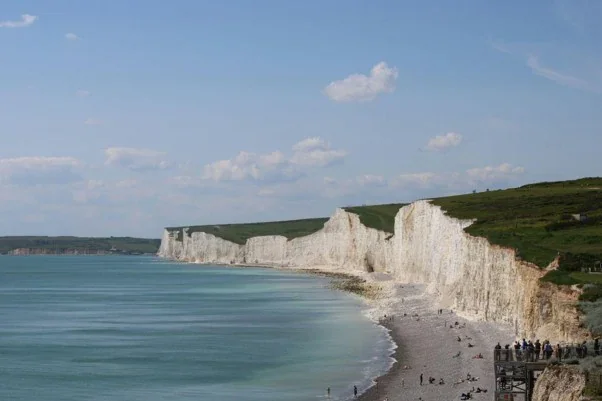
The White Cliffs of Dover mark the point where Great Britain comes closest to continental Europe. On a clear, sunny day, and if the deceiving British weather allows, one can see France across the English Channel. The White Cliffs not only offer a picturesque view of the countryside, but they also stand guard as the gateway to England.
When Julius Caesar invaded Britain in 55 BC, his army was confronted by these very cliffs. Over 1,900 years later, the same white cliffs greeted the soldiers rescued from Dunkirk. Then, during an aerial battle in 1941, they saved an Indian Sikh Royal Air Force pilot-a man who would go on to become one of the most prominent figures in the history of both Great Britain’s and India’s air forces.

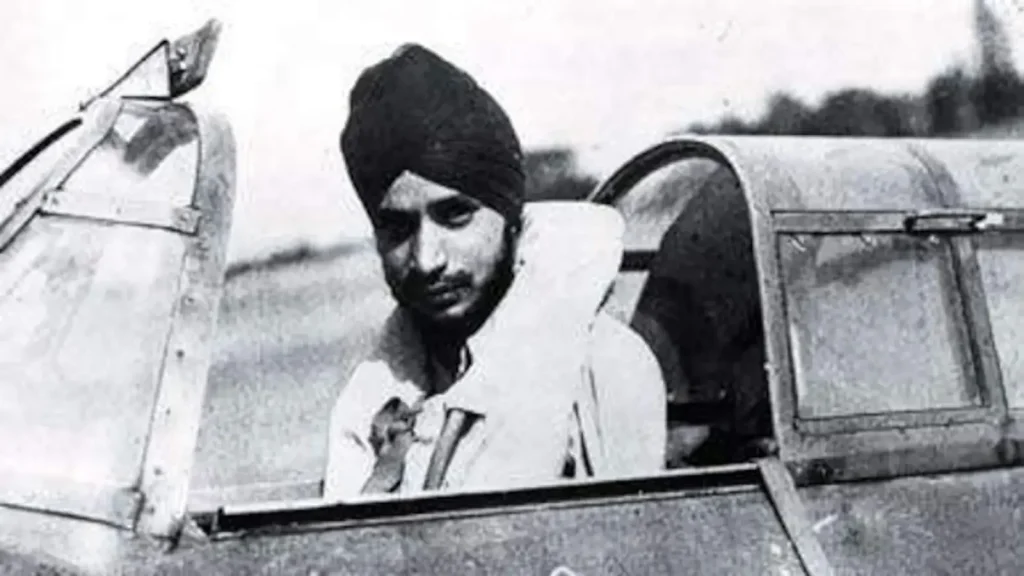
Pujji belonged to a well-educated family, and his father was a government officer during British rule. His first job was flying passengers from Haridwar to Badrinath. Britain was at war again with Germany. The trainees arrived at Liverpool station and then went to London. World War II was about close shaves for pilots, when air combat meant intense dogfights. Pujji’s plane crashed twice during the war. In one of the aerial engagements over the English Channel, a German Messerschmitt opened fire on his plane. There was sea on one side and the White Cliffs on the other. He saw the cliffs and crash-landed. The African theatre was where his plane was shot down by ground fire. He survived, yet again. After serving in North Africa and the Western Desert for a few years, he and other Indian pilots were sent to India and were posted to No. Squadron Leader Mahinder Singh Pujji earned a rare distinction of serving all three theatres of operation – Europe, North Africa, and Burma. Ldr Pujji became an Aerodrome officer at the Safdarjung Airport. He continued to fly as a civilian and was one of the pioneers of the gliders’ club in India, through which he once met Prime Minister Nehru.
Because he didn’t know how to swim, he was advised to glide the plane to the shore. This marked his final rank prior to his departure from the Air Force in 1947, due to medical reasons. Mahinder Singh Pujji was born in Simla on August 14, 1918, a day that would become iconic in the history of India and Pakistan 29 years later in 1947. Pujji was a hobby pilot at the Delhi Flying Club and received his ‘A’ level flying certification in 1937. In 1938, he was offered a better position at Burmah Shell – which later became Bharat Petroleum Corporation Limited (BPCL) – as a refuelling superintendent. The insecurities that were brewing in Europe since WWI reached their peak when Germany invaded Poland in 1939. Mahinder Singh Pujji and 23 other pilots arrived in Britain during the peak of the Battle of Britain in 1940, when German bombers rained hell on London with V2 rockets and bombs. The batch of 24 Indians was invited to Windsor Castle near London to have tea with the King and the Royal Family along with the Secretary of State. After serving in the Battle of Britain, he was sent to North Africa, where he served in the Middle East and Africa theatre in 1941. 4 Squadron in Kohat in 1942. He attained the rank of Squadron Leader by 1945. In 1945, he was awarded the Distinguished Flying Cross (DFC). He later left the Air Force after being diagnosed with tuberculosis and a 100% disability.
The first 24 received much attention in Britain, and there was “huge publicity” around it, Pujji said in an interview. In his autobiography, For King and Another Country, he recalled the attack and said, “A hail of bullets smashed my dashboard to smithereens and sent engine oil arcing across the cockpit, completely obscuring my vision”. “I only knew I was 200 feet up, but by God’s work, I crash-landed,” he said. For Pujji, the African theatre was more primitive than Europe, with food being a “turn-off”. He said he survived on biscuits on some occasions. Doctors at that time told him that he had six months to live, but Sqn.
