
Bangladesh seems to have made the Sheikh Hasina issue a central pillar of the bilateral relationship. But India is signalling that business and people’s issues should remain the central pillar, while politics can continue in its own way. India believes that business-to-business and people-to-people ties should take precedence, while Bangladesh has postponed a planned visit of Prime Minister Tarique Rahman over a political issue that flared after former PM Sheikh Hasina, who was evacuated to India by Bangladeshi authorities in August 2024, held an interaction with the press at an event organised by the Foreign Correspondents Club of South Asia based in New Delhi.
Politics will continue in its own way. And I have no doubt that the future is very positive. Let it take its own time. And let us work together for each other’s people. Bangladesh is a vibrant, sovereign, independent country. So is India. Nobody is big, nobody is small. All are equals, and we have to work on that footing.”
But business and what is due to the common man, giving that is our responsibility.
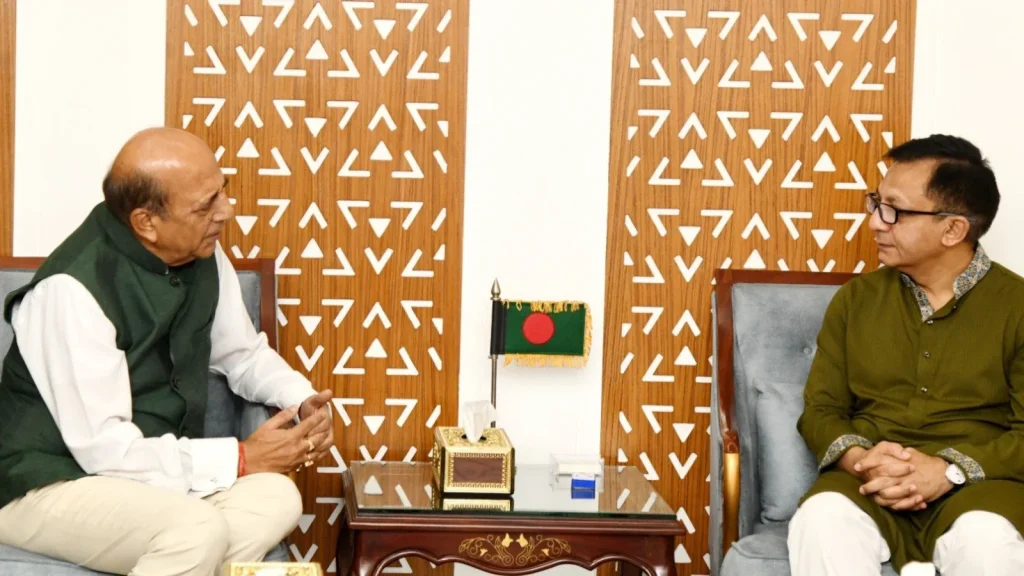
After a meeting with Bangladeshi Minister of Commerce, Industries, Textiles and Jute, Khandaker Abdul Muktadir, India’s High Commissioner to Bangladesh, Dinesh Trivedi, said, “Let us have business-to-business ties together.
They want education, health, jobs, good roads and electricity. This will happen with business-to-business ties. So the point is that from my level, we will continue to talk about this. But our officers and Bangladesh commerce ministry officers — they need to be in regular touch. There are two sides to it. One is the political level and it will be there. I always say there will be issues in a democracy. And the other thing is what people want: development. He also highlighted interdependency as a key factor of the India-Bangladesh relationship and Bangaldesh’s Commerce Minister Khandakar Abdul Muktadir agreed with him. “Interdependency is a permanent solution. I depend on you for development and you depend on me. And this dependency is a family. And we want to carry this forward. “When the economy moves ahead of politics, the politics follows behind. Economy will bring development to the people. And when people think that this relation is good for us, then politics will be a compulsion. Both are important. I am not saying that one is more important and the other is less important. What do we want? The common people, I am in public life, the common people don’t expect much. They want the minimum. What they want most is peace. In English, we say peace and prosperity. When there is peace, there will be prosperity. And I think this is the responsibility of both countries.
Because of the deterioration in ties since August 2024, India-Bangladesh trade was valued Rs 13 billion, bangladesh Commerce Minister Khandakar Abdul Muktadir highlighted that despite the differences and the restrictions. Which means that economic considerations often override a lot of other things. Because economic interests mean that the people in both countries will exercise their rights to enjoy services and purchases at competitive prices,” Bangladesh Commerce Minister Khandakar Abdul Muktadir said, i am completely in agreement with High Commissioner Trivedi and we have to look at our economic interests.
“Despite the differences and restrictions, bilateral trade between the two countries is $13 billion.
Responding to a question on the bilateral relationship in the current context, High Commissioner Dinesh Trivedi said, “The real question is what do the common people want? Other things will take its own time but this as the Commerce Minister said, I share the same opinion as him and I wish all the best for this,” the High Commissioner said. To give peace and prosperity to the young generation,” the High Commissioner said.
