
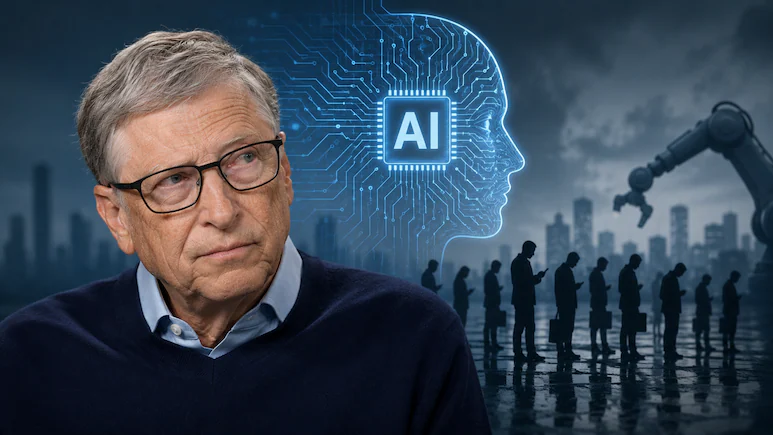
Bill Gates warned Wednesday that the world is dangerously unprepared for the upheaval brought by artificial intelligence, with the technology destroying jobs and threatening human connection, especially for young people.
“However, I don’t think that’s going to happen. The geopolitical and economic incentives are pushing too hard to go full speed ahead,” he warned. The first is permanent job destruction. Gates insisted comparisons to the shift from farm work to office work were misleading, as that transition unfolded over generations and created roles that still required human thinking.
In a nearly 6,000-word essay published on his blog, the Microsoft co-founder said the shift into the AI era will rank among the most turbulent periods in human history and that no one has produced a credible plan for managing it.
His stance will draw significant pushback from many in Silicon Valley and the Trump administration who blame “doomer” attitudes among some tech leaders for giving the AI revolution a bad reputation. “AI will either be the greatest equalizer ever invented, or the worst source of injustice,” wrote Gates, 70, who now chairs the philanthropic foundation that bears his name. “There is no plan to ease the entry into the AI era,” Gates said, adding that he would likely support one if it existed. Gates said he saw three main risks arising from the fast deployment of AI.
AI’s Impact on Jobs and Security Risks
Bill Gates has warned that artificial intelligence (AI) could replace many jobs in law, medicine, customer service, software, and manufacturing within the next decade. Entry- and mid-level positions are particularly vulnerable, raising concerns for young people entering the workforce with fewer job opportunities.
As robots become more affordable, blue-collar jobs in construction and hospitality are also expected to face pressure by the end of the decade. Gates suggested that some roles should be preserved for humans, even if AI can perform them more efficiently and cost-effectively.
In addition to job displacement, Gates highlighted cybersecurity as a significant risk. He noted that attackers are advancing quicker than defenders can secure systems, alarming cybersecurity experts. Critical infrastructure such as hospitals, banks, water systems, and power grids are particularly at risk.
Lastly, Gates raised concerns about how AI could affect children and human relationships, indicating a broader societal impact beyond just employment and security issues.
Gates acknowledged he retains deep financial ties to the technology industry, saying investment profits will flow to his foundation, which plans to spend its remaining $200 billion over the next two decades.
Citing research, Gates said AI chatbots that never challenge or frustrate users risk becoming addictive and deny people the chance to build social skills. AI bots “rob us of the lessons we learn from connecting with other people,” he wrote. The essay comes months after Gates was interviewed by the House Oversight Committee over his ties to the late sex offender Jeffrey Epstein, telling lawmakers in June that the association was “a grave error in judgment.” (Except for the headline, this story has not been edited by NDTV staff and is published from a syndicated feed.)
