
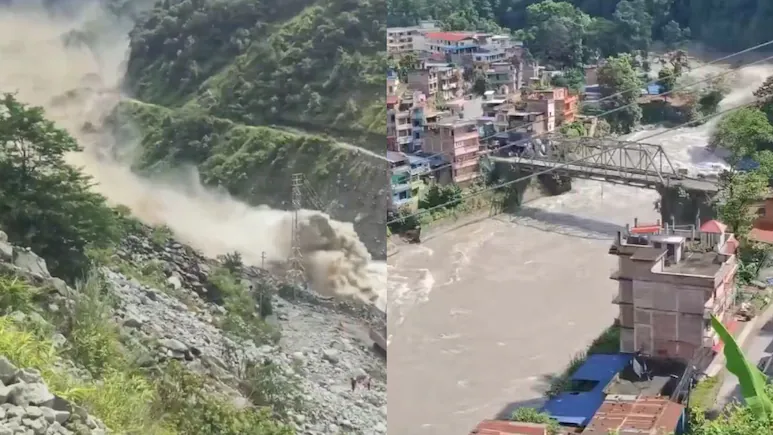
A recent glacier collapse in Nepal’s Rasuwa region has resulted in a significant flash flood, highlighting the ongoing risks associated with unchecked construction near Himalayan rivers. Experts warn that traditional mountain communities often mitigate these dangers by constructing their homes at higher elevations, away from riverbanks. This incident serves as a stark reminder of the vulnerabilities faced by areas engaged in extensive development along these volatile landscapes.
Today, however, rapid development has transformed the landscape. Speaking to NDTV from Chengdu in China, Dr Mohd. It is a compound disaster. “So far, it seems it is an ice and rock avalanche. But beyond the immediate devastation, Farooq emphasised a lesson that Himalayan communities and policymakers have repeatedly failed to learn. Rivers are dynamic systems, and building homes, markets and infrastructure too close to them or on floodplains can dramatically increase vulnerability when disasters strike. “If we see indigenous Himalayan people in old times, they used to be away from these rivers. That traditional wisdom evolved through generations of living in fragile mountain terrain. Villages were often located on elevated slopes and ridges where residents were protected from sudden floods, landslides and debris flows that frequently accompany Himalayan disasters. Getting drinking water from down below was always a problem, but safety first played out, reducing the risk. Farooq noted that settlements are increasingly appearing close to riverbanks and in some cases even above river channels themselves. “Now settlements are happening very close to river banks and sometimes over the rivers. They have some overhanging pillars and structures, and they establish some shops and markets,” he warned. Farooq cautioned that the opposite may be true. The flood can erode slopes, destabilise valley walls and loosen huge volumes of sediment. Even relatively small triggers such as rain, local slope failure or minor seismic activity can then set off landslides and additional destructive events. “So, if anything happens, even at a much smaller scale, it may be very dangerous downstream. Nepalese authorities have already advised residents to stay away from riverbanks and remain alert. Farooq strongly supports that precaution. A red alert continues to be maintained. For the long term, however, he believes the answer lies in smarter planning rather than emergency response alone. His warning extends beyond Nepal. Many river systems originating in the Himalayas cross national borders and affect millions of people in China, Nepal and India. Disasters do not recognise political boundaries. Flash floods generated high in the mountains can travel long distances downstream, threatening communities far away from the original trigger point.
Because of the scale of destruction reported downstream, the disaster has already become one of the most destructive recent Himalayan events, drawing comparisons with India’s Chamoli disaster of February 2021 and even the Kedarnath tragedy of 2013. Because residents often return to damaged areas soon after the main event, believing the danger has ended, this warning is particularly significant. Farooq called for stronger land use policies across the Himalayan region so that settlements and infrastructure projects are planned with full awareness of geological and climatic hazards.
The Leh floods of 2010, Kashmir floods of 2014 and other such disasters all point to the fact that construction done in floodplains is most vulnerable to flooding risks.
Farooq Azam, Senior Intervention Manager for Cryosphere at the International Centre for Integrated Mountain Development (ICIMOD), Kathmandu, Nepal, said the disaster appears to have been triggered by an ice and rock avalanche or glacier collapse that unleashed a destructive flood downstream, causing extensive damage to infrastructure, homes, bridges and hydropower projects. Farooq said the current understanding points to a glacier collapse near the Nepal-Tibet border that generated a cascading flood wave through the river system While scientists are still analysing the exact chain of events. We can say it is kind of a glacier collapse,” he said. The houses are always at very high altitude,” he said. “The area is even more vulnerable than before yesterday,” he said. He said communities should avoid rivers during the monsoon season when water levels are already high and any additional flood surge can become particularly dangerous. “We need to have better land use policy in the whole Himalaya,” he said.
Farooq pointed out that indigenous mountain communities had historically understood this risk far better than many modern planners.
The destruction witnessed in Rasuwa appears to underline that concern. The powerful flood wave tore through downstream infrastructure, damaging hydropower facilities, homes and bridges. Farooq explained that the warming rate in high mountain areas is significantly faster than the global average. Scientists describe this phenomenon as elevation-dependent warming. This affects the permafrost. The destruction can leave entire mountain slopes weakened and unstable, increasing the risk of follow-on disasters for weeks or even months. “When the river is hit by this flash flood, the sidewalls and the area become more vulnerable to secondary landslides. As investigators continue to analyse satellite imagery and field data from Rasuwa, one message is already becoming clear. The tragedy is not only about a glacier collapse or a mountain flood. It is also a reminder that when homes, markets and infrastructure move closer to rivers, they move closer to danger.
The event occurred in a region that is already highly vulnerable due to climate-driven changes taking place across the Himalayas.
The disaster affected multiple hydropower projects and large numbers of houses while destroying bridges across a wide stretch of the river corridor, according to Farooq. “The Himalayan mountain range is warming at a faster rate compared to global warming,” he said. A large flash flood does not simply end once floodwaters recede, according to him. “More important is the post-disaster, secondary disaster,” he said.
As temperatures rise, glaciers, snowfields and frozen mountain slopes become increasingly unstable. That means a greater likelihood of rock falls, glacier collapses, avalanches and flash floods. In the case of the Rasuwa disaster, scientists believe several factors may have combined. Preliminary assessments suggest that an earthquake may have acted as a trigger, but there is no certainty on the exact sequence. One important conclusion emerging from initial investigations is that this was probably not a traditional Glacial Lake Outburst Flood, commonly known as a GLOF. Scientists have not identified a large glacial lake at the source area. Instead, the evidence currently points toward a massive ice and rock avalanche that collapsed into the valley and generated the deadly flood. Yet for communities downstream, the distinction matters little. The result remains the same: a rapidly moving surge of water, debris, rock and sediment capable of destroying everything in its path. Farooq stressed that another major concern often begins after the initial disaster has passed.
Farooq said abundant snowmelt and unusually warm conditions may also have contributed to the instability. “When disasters are happening in the Himalaya, a lot of factors are playing together,” he explained.
The old Himalayan practice of building on higher ground may have lacked modern engineering, but it often reflected a deep understanding of mountain risks. In a warming Himalaya where extreme events are becoming more frequent, that traditional wisdom may hold important lessons for the future.
