
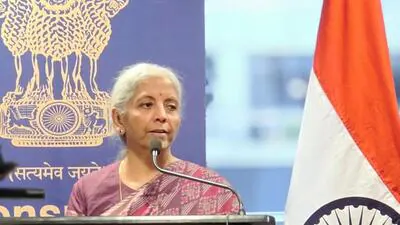
India’s economy continues to expand at a rate of 7% or more since the Covid-19 pandemic, according to Union Finance Minister Nirmala Sitharaman. Speaking to the Indian diaspora in Chicago, she expressed confidence that this growth trajectory will persist despite prevailing global uncertainties.
The finance minister’s statement came close on the heels of the Reserve Bank of India’s latest growth projection on August 5. India’s real gross domestic product (GDP) growth for 2026-27 is projected at 6.7%, according to the RBI.
“So, reforms continue. We have given ourselves a fiscal discipline path on the fiscal deficit as well. We have fulfilled the trajectory. So, the speed and scale with which the reforms are happening require a lot more support. Lots more support from people who are talented and have exposure. Lots more support from people who can give ideas for us to carry it forward. And, above all, support in terms of capital, which is so required for a country to meet all its aspirations,” she added.
Because multilateral institutions are very slow…, she said, we are also talking with several countries for bilateral investment treaty and also bilateral trade agreements. Therefore, I will be working on that path. The RBI increased its latest GDP growth rate projection by 10 basis points from its June estimate as the economy weathered the storm generated by a turbulent global geopolitical environment, trade-related uncertainties and an unpredictable monsoon in the first quarter of 2026-27. The government continues to give urea at ₹ 300 per bag to Indian farmers, while its procurement cost is ₹ 3,000 per bag, she said. Talking about fiscal management, she said, “We have set ourselves a certain target, which is to bring the borrowing down to the 50% level of GDP by 2030. There are advanced economies whose debt is well over 200% of their GDP even now. The last mile that had to be reached by 2025-26, we have reached,” she added. She said 2047 is the target year set for achieving Viksit Bharat. “It’s hardly 20 years from now.
the government paid a huge price to procure fertilisers for farmers from global suppliers, she said While the crisis has been managed. “So, ₹ 2,700 is the subsidy we give per bag of fertilizer,” she said, adding that “there is no shortage” of fertilizer for farmers and no burden of the cost is shifted to them. The finance minister said irrespective of global uncertainties, India is marching on the reform path with its focus on bilateral trade and investment cooperation with several economies and accelerating the domestic engine of growth through capital investments for their multiplier effects.
