
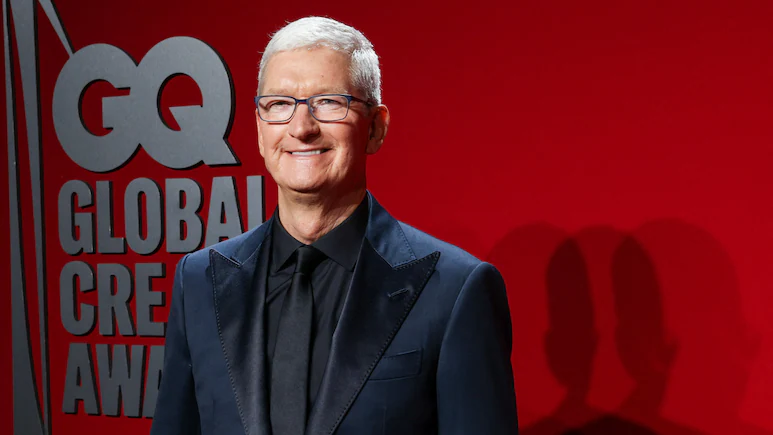
When Tim Cook took over as chief executive of Apple in August 2011, following Steve Jobs’ second departure from the company amid his deteriorating health, expectations were sky-high and doubts were equally strong.
Cook was widely viewed as an operations and supply-chain expert rather than a traditional product guy like Jobs. The key question at the time was whether he could sustain Apple’s extraordinary run of innovation and growth. Fifteen years later, the numbers offer a compelling answer. The expansion has been supported by resilient iPhone demand, a rapidly growing services business and the company’s continued global expansion.
Under Cook, Apple’s market capitalisation has surged from roughly $350 billion to around $4 trillion, while its stock has jumped nearly 25-fold. Apple shares, which traded at about $13 when Cook assumed the top job, have risen 2,359.2 per cent to $319.70 at the latest close. Apple’s annual revenue has also grown dramatically, rising from about $108 billion in 2011 to more than $400 billion.
A year later, the company launched AirPods, helping turn wireless earbuds into a mainstream consumer category and creating another significant revenue stream for Apple. One of Cook’s biggest achievements has been transforming Apple into a business that extends well beyond hardware. Services including the App Store, Apple Music and Apple Pay have become an increasingly important growth engine. Cook also oversaw a major shift in Apple’s chip strategy. The company moved away from its dependence on Intel and began designing its own processors for Mac computers under the Apple Silicon platform. The transition gave Apple greater control over performance, product development and its broader hardware-software ecosystem. His tenure also produced new product categories. Cook’s record, however, has not been without setbacks. Perhaps the biggest question surrounding Apple’s next chapter is artificial intelligence. Google and OpenAI have moved aggressively to integrate AI into consumer and enterprise products, Apple has taken a more measured approach, emphasising privacy, software integration and on-device computing While Microsoft.
The services segment now generates more than $100 billion annually and carries broader margins than Apple’s hardware business. Apple introduced the Apple Watch in 2015, with a focus on health, fitness and everyday connectivity. Apple Maps, launched in 2012, faced widespread criticism over inaccurate and incomplete data in its early days.
Apple also eventually abandoned its ambitious electric and autonomous vehicle programme, known as Project Titan. After years of development, high costs and an uncertain commercial path led the company to pull the plug on the project. More recently, the Vision Pro mixed-reality headset, introduced in 2023, has struggled to achieve broad adoption, with its high price emerging as a major barrier for consumers.
That strategy could become one of the defining tests for Cook’s successor, John Ternus. Apple has made progress in bringing AI capabilities into its ecosystem, but the company faces growing pressure to match the pace of rivals in a technology race that is reshaping the global tech industry. Yet the transformation in Apple’s scale remains difficult to overlook. (This story has not been edited by NDTV staff and is auto-generated from a syndicated feed.)
Cook’s Apple journey has therefore been a mix of extraordinary financial growth, successful new businesses and products, alongside ventures that failed to meet expectations.
