
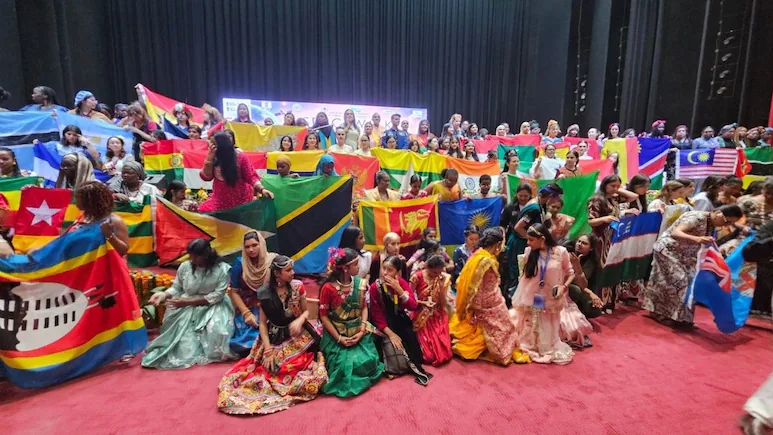
In a remarkable display of global Gen Z girl power, schoolgirls representing 108 countries gathered in Greater Noida with a shared dream that reaches far beyond national borders, beyond Earth orbit and ultimately towards the Moon itself.
The initiative is called Mission ShaktiSat, an ambitious all-girls satellite programme led by Chennai based Space Kidz India, a pioneering organisation that has spent years introducing children, especially girls, to the world of space science and satellite technology. For this generation of aspiring scientists, engineers and explorers, ShaktiSat is much more than a satellite. It is a statement that girls can be builders, designers and leaders of the future space age. Held with support from the Indian Space Research Organisation (ISRO), Indian National Space Promotion and Authorisation Centre (INSPACe) and Gautam Buddha University, the event brought together young participants from across continents, creating what is perhaps the world’s largest gathering of budding aerospace girl scientists ever assembled in India. At the centre of it all stood a satellite called ShaktiSat. Speaking to NDTV, Dr Kesan explained that while senior engineers guide the process, the girls themselves have actively participated in major aspects of the programme. “They have made the engineering structures which children can do. Inspired by the response and by the challenges faced by women across the world, Dr Kesan decided to dramatically expand the concept. These teams need to work together for the future. The mission carries a powerful symbolic objective as well. Shukla instantly connected with the young participants. Asked whether these schoolgirls could become future aerospace scientists, he offered an emphatic endorsement. “The one thing that I realised is that space exploration is inherently very collaborative in nature. “I myself learned so much, which I never thought I would have learned sitting all the way across the world. From Rwanda came Rumuri, another ShaktiSat girl engineer in the making. She described learning satellite systems while collaborating with fellow participants from across the globe. Asked about her future ambitions, her answer captured the dreams shared by many participants. “I want to be a scientist. I want to know about space. Representing Moldova was Paula, who worked on the satellite’s solar panels. She added that the experience had taught lessons extending beyond engineering. “We learned a lot about teamwork, not only space technology. “I would be very happy to hear that. I would like more and more competition. Shukla added, “I wish more and more kids get involved in this futuristic science and space exploration domain. One aspect of Shukla’s interaction stood out. Asked how it felt to be commanded by a woman astronaut, Shukla’s admiration was unmistakable. “Peggy was such a big inspiration for me. Standing before them, India’s newest astronaut summed it up best. For these thousands of young participants, ShaktiSat may begin in Low Earth Orbit. But their aspirations are already aimed much higher. “No dream is too big! Their destination is nothing less than the Moon.
I want to travel around the space so that I am going to be an astronaut. Because he recognises that these young girls could one day become his colleagues and perhaps even competitors in space, for Shukla, seeing such enthusiasm was particularly meaningful. Space Kidz India has requested an October 11 launch, coinciding with the International Day of the Girl Child. Adding prestige and inspiration to the programme was Astronaut Group Captain Shubhanshu Shukla, India’s newest space explorer who recently flew to the International Space Station as part of the Axiom-4 mission in 2025. Among the participants was even a 12 year old girl who travelled alone from Benin in West Africa to be part of the programme, underlining both the international appeal of the mission and the determination of its young participants. During the Axiom-4 mission, he flew under the command of legendary American astronaut Peggy Whitson, widely regarded as the most experienced American astronaut.
“108 countries, 12,000 girls, mission to the moon is objective of ShaktiSat,” said Dr Srimathi Kesan, Founder and CEO of Space Kidz India, widely known as the “Space Amma” of India. So yes, what they have made is going space and then to the moon,” she said. “So I said, why not bring in everybody? So bring everybody together, teach them basic space education until the launch,” she said. “If we can have the launch on October 11, being the International Girl Child Day, that is going to send a loud message from India to the world,” Dr Kesan said. “I think absolutely anybody can make great aerospace scientists given the intent and the hard work that it requires,” he said. Drawing from his own experiences in astronaut training and human spaceflight, Shukla said space exploration fundamentally depends on collaboration. The value of teamwork is what I realised during my mission” said Shukla. She said students worked on important functions and payload parameters while simultaneously learning from scientists and industry experts. “We build it and we are going also to help to launch it,” she said proudly. “My role, I actually worked on the solar panels, on the satellites,” she said. When told that these students might provide competition during future missions, he welcomed the idea wholeheartedly. “I hope that these girls who are participating in this also become an example for many other girls who can follow in their footsteps,” Shukla said. Shukla said “Come out, be aware, know what is happening in the world, work together in teams and make great things happen for humanity as the citizens of Earth.
The project’s roots go back to Space Kidz India’s earlier satellite missions involving girls.
He noted that despite her record breaking achievements, Whitson had faced nine rejections and setbacks before eventually becoming an astronaut. “That goes to show her resilience, the willpower and the determination. Then came a comparison that perfectly captured the spirit of the event. Looking at the girls assembled before him, it was easy to imagine that these were `Peggys’ in the making. Future astronauts, mission commanders and scientific leaders who may one day shape the next era of human exploration. The significance of ShaktiSat extends beyond technology. For many students, the interaction with India’s President reinforced a powerful belief that no dream is out of reach. That same message was echoed by Dr Rana Pratap Singh, Vice Chancellor of Gautam Buddha University, one of the institutions supporting the programme. Addressing the gathering, he described the event as an unprecedented moment.
Many participants were earlier hosted by President Droupadi Murmu at Rashtrapati Bhavan, where they received encouragement and recognition for their work.
He praised the organisers and participants alike. “My compliments to the entire team of Space Kidz India and all the people who are associated with this programme, to all the girls who are involved, more power to them. The enthusiasm among the students was impossible to miss. Shreya Sandeep Muzumdar, representing the United Arab Emirates, described her involvement in technical aspects of the project.
“Our role as students was basically assisting and helping and figuring out the technicalities of what goes into the structure of a satellite, the thermal part of it, the electronics part of it, at least the coding part of it.”
“Girls from all these different countries are coming together to make a single payload and satellite that will be launched to space. Participants were exposed to space science, coding, electronics, payload systems, satellite structures and mission design. The long term vision is to create satellites that will first operate in Low Earth Orbit and eventually contribute to a lunar mission. Looking at girls from over a hundred countries working on a common spacecraft, he saw a powerful reflection of that principle. I think it cannot get better than this. “This Gen Z will propel the world to new heights. All have one goal. No dream is too big. As the event concluded, the message could not have been clearer. A satellite stood as the centrepiece. But the real story was the generation surrounding it. They were learning to build satellites, understand payloads, code systems and think like engineers. Most importantly, they were learning to dream without limits.
The mission aims to involve 12,000 girls worldwide. We have never seen such girl power from 108 countries. Young girls from 108 countries speaking different languages, carrying different passports and coming from vastly different backgrounds had gathered with a shared mission.
Going to the Moon” Singh, himself a space biology scientist, told NDTV.
