
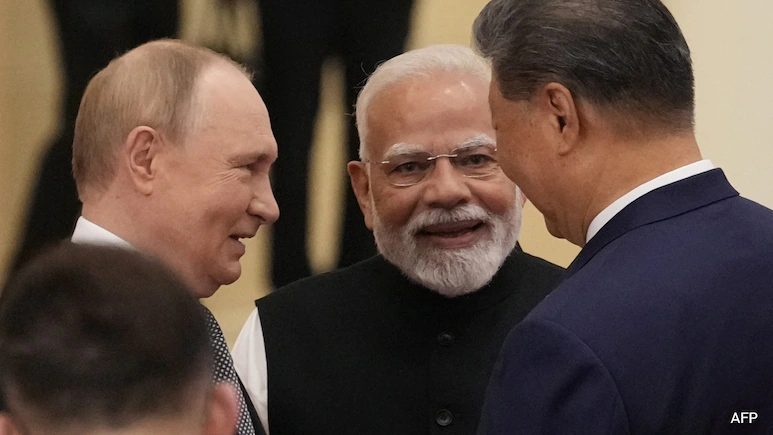
Prime Minister Narendra Modi, Russian President Vladimir Putin, and China’s Xi Jinping, along with over a dozen other world leaders, are visiting Kyrgyzstan for a two-day summit of the Shanghai Cooperation Organisation (SCO) — a regional bloc that seeks to establish itself as a counterinfluence to the West.
During the summit, Putin, Xi, and PM Modi, along with Iran’s President Masoud Pezeshkian and Pakistan’s Prime Minister Shehbaz Sharif, will take part in a plenary session chaired by Kyrgyz leader Sadyr Japarov. This year as well, all eyes are on the summit being held in Kyrgyzstan’s capital, Bishkek, where the leaders of the 10-member bloc are again set to share a stage.
Last year, the grouping’s annual meeting in Tianjin, China, caught global attention when PM Modi did a three-way handshake with Xi and Putin, prompting US President Donald Trump to declare that Washington might have “lost” New Delhi and Moscow to Beijing.
In his departure statement on Saturday, PM Modi said he looked forward to advancing India’s vision for the region, anchored in “security, connectivity and opportunity, and to working with fellow members for a region free from the scourge of terrorism, separatism and extremism, which continue to threaten peace and stability. The group, which is celebrating its 25th anniversary, brings together Russia, China, India, Pakistan, Iran, four Central Asian countries, and Moscow-allied Belarus. Turkey’s Recep Tayyip Erdogan is also expected to attend, though his country is not a formal member. The meeting is also expected to set the tone for the upcoming BRICS Summit in September in New Delhi. Relations between member states, including India’s with China and Pakistan, are also expected to be discussed, bringing some of the SCO’s own internal tensions onto the agenda. Prime Minister Narendra Modi has arrived in Kyrgyzstan to attend the SCO summit. On the sidelines, he is scheduled to hold bilateral meetings with SCO leaders, including Iranian President Pezeshkin, Kyrgyz President Zhaparov, and Russia’s Putin. This time, apart from India, Tajikistan is another member competing for the status. PM Modi may try to use the platform to convince Tajikistan to postpone its candidate for one year. The Bishkek summit takes place as some SCO members are in the midst of real wars — the Ukraine and Iran conflicts — or trade wars, with the imposition of US tariffs on Chinese and Indian goods. The Russian president hopes to use this opportunity to counterweight Western influence in the region and restore his country’s standing in the region even while the Ukraine war drags on. Pezeshkian, who is also attending the summit seeking to gather support against US aggression, will also hold bilateral meetings with several participating leaders, including Sharif and the presidents of Kyrgyzstan and Tajikistan. Russia and Iran are among the most sanctioned states in the world and have massively deepened their military and economic ties since Moscow invaded Ukraine. It also has two observer countries: Afghanistan and Mongolia. But Putin and Xi have repeatedly made anti-Western speeches during its summits.
New Delhi might use the summit to vie for the Asian bloc’s vote for the non-permanent seat in the UN Security Council election in June 2027. In 2009, India had convinced Kazakhstan to withdraw from elections for the 2011-2012 term and later supported Kazakhstan to win the 2017-2018 term.
Arriving in Bishkek on Sunday, Xi hailed what he described as a “golden period” in relations with Central Asian Kyrgyzstan as China deepens its influence in the historically Russia-dominated region. “I also look forward to meeting President Zhaparov and other SCO leaders,” he said. the Russian leader has planned bilaterals with PM Modi and Pezeshkian, among other leaders, Kremlin spokesman Yuri Ushakov said While Xi’s schedule remains unclear apart from meeting with Putin. On top of its 10 members, it now has 15 “dialogue partners,” including Turkey, Saudi Arabia, and Qatar. The SCO’s founding declaration says the group is “not an alliance directed against other states. At last year’s gathering, Putin accused Western countries of provoking the war in Ukraine, while Xi denounced “acts of intimidation,” referring to US-Chinese tensions.
Putin and Xi have previously used SCO summits to promote their vision of a multipolar world and present a united front against the West. recent votes suggest otherwise While earlier it was assumed that India’s position was assured. The SCO has historically focused on economic issues but has gained momentum in recent years under Moscow’s and Beijing’s leadership.
