
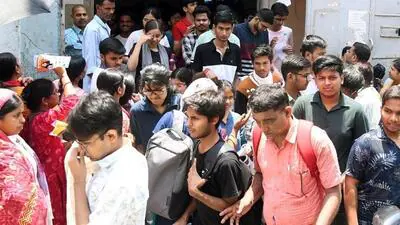
The Joint Entrance Examination (JEE) Advanced is testing a new assessment pattern through a pilot program involving approximately 4,000 students from various Indian Institutes of Technology (IITs). This initiative aims to evaluate the effectiveness of adaptive testing in accurately measuring student abilities while reducing reliance on coaching. The IITs are currently gathering data to determine the potential benefits of this approach.
IITs Plan Adaptive Assessment System by 2030
The Indian Institutes of Technology (IITs) are preparing to implement a new adaptive assessment system for candidates, which will adjust question difficulty based on individual performance. This initiative is expected to be rolled out as early as 2030, contingent on a minimum of three years of research and validation.
IIT director Agrawal emphasized that if the system is to launch by 2030, a formal announcement must be made by early 2027. Currently, the IITs are in the process of collecting and validating data to support this new assessment approach. The final decision regarding its implementation will be made jointly by the IIT directors and the Union education ministry after thorough evaluation of the collected evidence.
IIT Kanpur director Prof Manindra Agrawal raised concerns over the existing examination structure, including the growing influence of the coaching industry and the emotional and financial stress it places on students and families. “The aim of the current exercise is data collection and also correlation with the ability of students. The data on students’ responses and performance has been collected and is now being processed. Each IIT appointed a nodal officer to oversee the exercise. Under the proposed adaptive system, students would initially be given questions of different types and their performance would be used to assign difficulty levels as they progress through the test. IIT Kanpur is also examining automated generation of questions across difficulty levels, potentially using AI agents, to create a large database and ensure students receive fresh questions, reducing the scope for copying and cheating. Agrawal proposed adaptive testing of quantitative and reasoning skills, under which questions would be dynamically generated and their difficulty adjusted based on a candidate’s performance. The objective is to develop an examination that better captures critical thinking and reasoning abilities while reducing dependence on coaching and rote preparation. The council also proposed developing a question-generation tool capable of producing questions of varying difficulty levels. As an initial experiment, it suggested an optional adaptive test around two months before JEE Advanced to allow IITs to collect performance data and compare it with students’ actual JEE Advanced results. A white paper was also envisaged to lay out a phased roadmap for the transition. The institute will compare students’ adaptive-test scores with their JEE Advanced scores and performance in different IITs as part of a multimodal analysis. JEE is conducted in two stages. JEE Main, conducted by the National Testing Agency (NTA), is used for admission to NITs, IIITs and other centrally funded technical institutions and serves as the qualifying examination for JEE Advanced.
The proposal was first formally discussed at the 55th IIT Council meeting on August 25, 2025, after a gap of two years. The latest pilot, conducted recently, involved about 4,000 first-year students across multiple IITs. The IIT Council minutes, released in January 2026, recommended that the Joint Admission Board (JAB) and IIT Kanpur examine the proposal’s feasibility, operational requirements and potential to reduce coaching dependence and examination vulnerabilities. The latter is conducted by an IIT on a rotational basis and its rank is used for admission to undergraduate programmes at the 23 IITs.
The data generated would help build the adaptive mechanism,” Agrawal told HT. Agrawal said research in the US and other countries has found a high correlation between aptitude tests and innate intelligence, and IIT Kanpur is “now working to validate such findings in the Indian context.
