
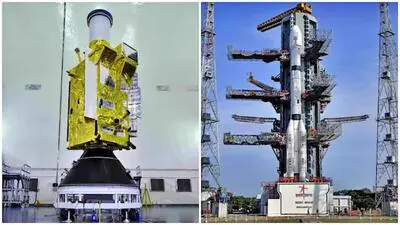
The countdown for the launch of an Earth observation satellite aboard a GSLV rocket began at the spaceport of Sriharikota in neighbouring Andhra Pradesh, the Indian Space Research Organisation (ISRO) said on Thursday.
It is a three-stage vehicle with a cryogenic upper stage. The GSLV-F17 is scheduled to lift off from the second launch pad at the Satish Dhawan Space Centre in Sriharikota, about 135 km east of Chennai, at 2.55am on Friday, carrying the Earth Observation Satellite-05 (EOS-05) into a sub-geosynchronous transfer orbit (Sub-GTO). The 27.5-hour countdown for the mission began at 11.25pm on September 2, ISRO sources told HT. Dubbed the ‘eye in the sky’ for its ability to monitor the Earth from an altitude of 36,000 km, the GSLV-F17 will be the 19th flight of the Geosynchronous Satellite Launch Vehicle. The GSLV, at a height of 51.7 metres, has a lift-off mass of 420.5 tonnes. The GSLV-F17/EOS-05 mission is a follow-up to the GSLV-F10/Earth Observation Satellite-03, which was ‘unsuccessful’ as it suffered a cryogenic upper-stage ignition failure after lift-off on August 12, 2021, at 5.43am from Sriharikota. The previous GSLV mission launched by ISRO was GSLV-F16/NISAR on July 30, 2025. It is the first-of-its-kind mission jointly developed by ISRO and NASA to image global land and ice-covered surfaces, including islands, sea ice and selected oceans, every 12 days.
It will also be the first imaging satellite to be placed in a sub-geosynchronous orbit, unlike earlier missions that used geosynchronous orbits, ISRO said. The objective of Friday’s mission is to provide near-real-time imaging of large-area regions at frequent intervals for quick monitoring of natural disasters and episodic events, and to obtain spectral signatures for agriculture, forestry and waterbodies, ISRO said. The Earth Observation Satellite would also share information for disaster warning, cyclone monitoring, cloudburst and thunderstorm monitoring, ISRO said.
GSLV Rocket Set to Launch Satellite into Geostationary Orbit
The Geosynchronous Satellite Launch Vehicle (GSLV) is preparing for a launch that will deploy a satellite weighing 2,367 kg into a geostationary orbit at an altitude of 36,000 km. This orbit allows the satellite to maintain a fixed position relative to the Earth’s surface, providing consistent imaging of India and its neighboring regions.
The GSLV will utilize a 4-meter-diameter ogive composite payload fairing and is equipped with a cryogenic upper stage. This design enables the rocket to carry heavier payloads, specifically satellites weighing up to 2,200 kg, into Geosynchronous Transfer Orbits (GTOs).
