
Storage is going to be a complex discussion, and purchase, for the next few months at the very least. In a way, the geopolitics and the artificial intelligence (AI) progression have turned the clock back, pricing solid-state drives (SSD) out of most budgets. This is particularly true when more storage space is a criterion.
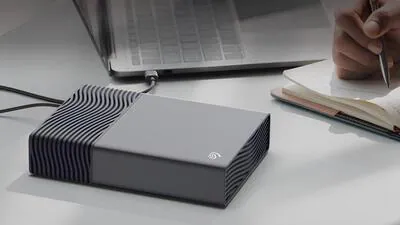
External 3.5-inch hard drives are very much in vogue (for the knowledgeable, they were never out of fashion), and the Seagate One Touch desktop external hard drive effortlessly ticks off three important boxes on the checklist—lots of storage space, single port connectivity, and a useful companion utility.
There are two reasons for this. First, a good old desktop hard drive, and secondly, there is space on the inside for not just some ventilation (you’ll see pronounced vent designs for that) but also for the bus-powered USB-C connection that transfers data and receives power over this single connection. Hard drives, unlike solid-state drives that don’t have moving parts, store data on platters that spin—the mechanism to get these going requires more power than SSDs.
The Seagate OneTouch itself is substantial in terms of its footprint, measuring 7.3-inches x 1.58-inches x 5.18-inches. That is, as long as the PC’s USB port is delivering at least 15-watts of power to get the drive spinning. I tested the Seagate OneTouch on a Mac Studio running the M4 Max with 128GB unified memory, and this bus-powered drive returned very impressive performance numbers for a 3.5-inch hard drive foundation. This peaked at 308.3MB/s in sequential write tests, and 306MB/s in sequential read speeds, in the Blackmagic Disk Speed benchmark. Safe to say, this is slightly faster than the latest generation WD My Passport drive, which is a 2.5-inch Hard Disk Drive (HDD) instead (and gets bogged down by a micro-B connector).
On battery power, the drive wouldn’t mount, and when the MacBook Neo was connected to its adapter, the Seagate OneTouch was usable but with some performance loss. Because the bus-powered proposition is really only useful if the computing device delivers at least 15 watts of power through the port you’ve connected it to, note that there may be a compatibility issue with the Seagate OneTouch. and also with an HP Pavilion laptop as well as a MacBook Pro 13-inch, the drive was intermittently unavailable on the MacBook Neo While this worked seamlessly with the aforementioned Mac Studio.
