
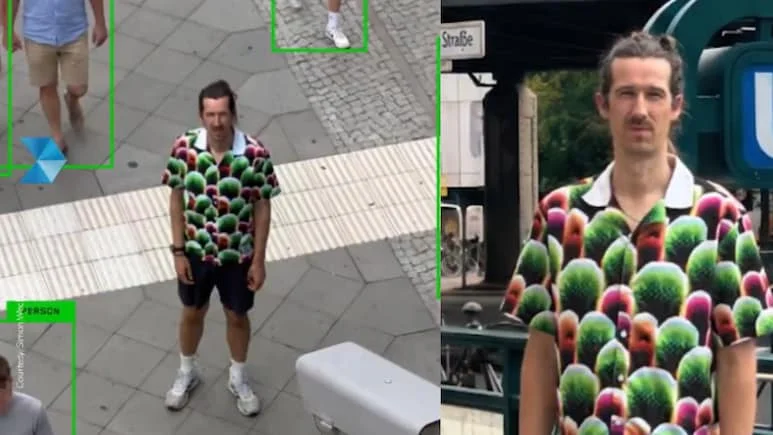
A designer has created a colourful shirt with the objective of confusing artificial intelligence (AI) systems used in video surveillance.
Called Digital Camouflage , the shirt was created by German artist and designer Simon Weckert. The shirt uses bright colours and unusual patterns to confuse AI-powered cameras and object-detection systems. Weckert created the shirt in response to a pilot project using AI-powered surveillance cameras at Kottbusser Tor in Berlin. The system is designed to monitor people and analyse their behaviour in public spaces. Instead, he sees it as a way of questioning whether people should automatically be monitored and analysed by machines while using public spaces. The shirt uses bright colours and overlapping patterns that can make it difficult for computer-vision systems to detect the outline of a human body. The designer developed the pattern using AI itself. The designs were then changed based on how confidently the system detected a person. The testing was carried out using YOLO, an open-source, real-time AI object-detection system. However, the shirt does not guarantee that a person will remain invisible to every surveillance system. Berlin’s Kottbusser Tor system is designed not just to record video but also to analyse behaviour and identify actions considered suspicious. It has been documented through photographs and videos at Kottbusser Tor.
The shirt is part of an ongoing project that began in 2025. The colourful garment costs around $77 to $100.
Weckert said Digital Camouflage is not intended as a tool to evade police or provide complete anonymity. “For a machine, a person is a bundle of visual statistics – and that is exactly its weakness,” Weckert told Dezeen . He used an “adversarial loop” in which different designs were repeatedly shown to an AI detection system. The detector stopped registering the wearer as a person during these tests, according to Weckert.
