
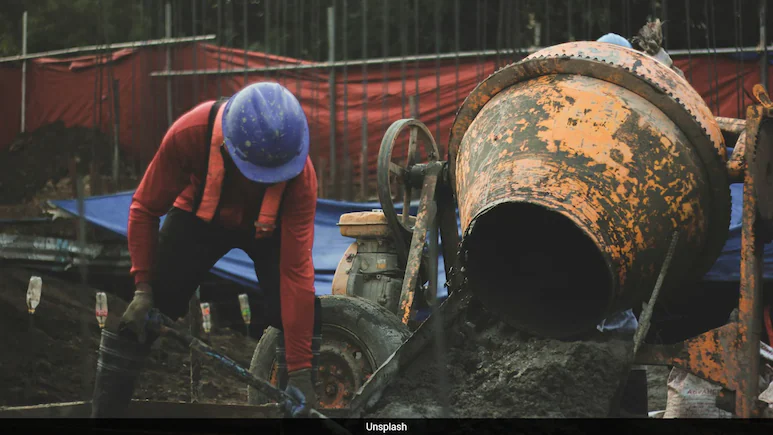
Scientists in India have developed a new type of concrete that uses treated human waste and can become significantly stronger than conventional concrete. The research was led by civil engineer Raghuvesh Tiwari of Manipal University Jaipur. The team used biochar made from human waste collected at a treatment plant in Warangal, India.
Replacing part of the cement with the material increased flexural strength by up to 42% after 91 days, although more research is needed before it can be used widely.
Biochar is a carbon-rich material produced by heating organic matter in an environment with very little oxygen. It was then ground into a fine powder. The results were promising. Scientists believe the porous biochar can absorb water and release it slowly as the concrete hardens. This may help the chemical reactions that strengthen concrete. The material also contains silica, which can contribute to the formation of compounds that improve strength. However, using more biochar did not necessarily produce better results. The study has been accepted for publication in Scientific Reports.
In this study, treated sewage sludge was dried and heated at temperatures of between 350 and 450 degrees Celsius. Concrete containing 5% biochar showed a 20% increase in compressive strength and a 36% increase in flexural strength after 91 days of curing. With 10% replacement, flexural strength increased by as much as 42%, while compressive strength rose by 21%. At 15% replacement, the concrete developed more pores and cracks and its overall strength was lower.
