

Is the exodus of leaders from the Bahujan Samaj Party (BSP) in Uttar Pradesh a signal of the decline of the once-powerful political entity symbolised by the giant elephant? In yet another major setback ahead of the general elections, Lok Sabha MP Ritesh Pandey resigned from the Mayawati -led BSP and joined the BJP on February 25.
Reports suggest that three more BSP MPs are poised to follow suit before the general elections, with another BSP MP considering a switch to Jayant Chaudhary’s Rashtriya Lok Dal (RLD).
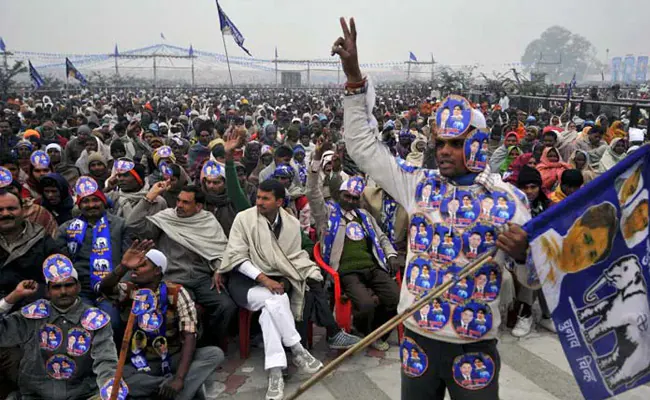
It appears that BSP leaders, in a last-ditch effort to salvage their political futures, are fleeing to safer havens, leaving the once formidable party in a state of limbo. Following the seat pact between the SP and the Congress in Uttar Pradesh , BSP leaders fear diminished electoral prospects as the contest shifts into a direct confrontation between the BJP-led NDA and the SP-Congress combine. Rank opportunism and shrewd manoeuvres have defined Mayawati’s political career. Riding on the promise of political empowerment for Dalits, Muslims, and other marginalised social groups, she served as Uttar Pradesh chief minister four times, aligning with different parties at different times. These electoral alliances were strategically formed to benefit the BSP, with tie-ups being discarded once they no longer served its interests. Muslim voters, too, have oscillated between loyalty to the SP and the Congress, perceiving these parties as better-equipped to challenge the BJP. The BSP’s decision to contest alone further diminishes its appeal, resulting in a shift of Muslim votes to the SP-Congress alliance. “Dalit vote of the BSP will mainly shift to the BJP. Muslims may move to the SP-Congress alliance as there is no third alternative. Shukla, a senior political analyst based in Lucknow. With many alleged corruption cases pending against her, Mayawati has adopted a guarded approach as far as her politics is concerned. For the BJP, it suits to use the BSP as the ‘third party’ to turn the battle in Uttar Pradesh into a triangular one. The upcoming general elections are poised to be a two-party contest in Uttar Pradesh, between the BJP and the SP-Congress alliance. With Dalits increasingly gravitating towards the BJP over the past decade, the BSP might not be averse to subtle collaboration with the party.
Another BSP MP from Jaunpur joined Rahul Gandhi’s Bharat Jodo Nyay Yatra on February 25. Consequently, out of a total 10 MPs in 2019, Mayawati’s party may end up with retaining only two. Despite disappointment from both INDIA bloc parties and her own party leaders, Mayawati has remained steadfast in her stance that the BSP will contest the upcoming elections alone , notwithstanding its previous alliance with SP-RLD in 2019, which yielded 10 seats. Even in 2019, Mayawati terminated the alliance with the SP’s Akhilesh Yadav, her arch-rival, despite its electoral gains, leading to the BSP winning only one seat in the 2022 assembly elections while contesting alone. The SP in contrast got 111 seats. The BJP’s Jatav support base has surged from 5% in 2012 to 21% in 2022, while its non-Jatav base has expanded from 11% in 2012 to 41% in 2022.
Though BSP may not be in a winning position, it will still try to keep its vote share intact,” says J.P.
Previously, Ghazipur MP Afzal Ansari had already secured a Samajwadi Party (SP) ticket from the same seat, while Amroha MP Danish Ali, suspended by the BSP for anti-party activities , is set to join the Congress.
