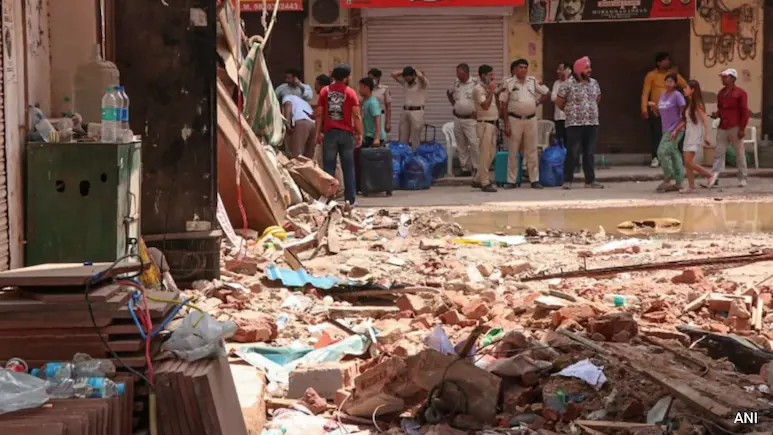
A private hostel in the Satya Niketan area of southwestern Delhi collapsed, resulting in the deaths of seven people, predominantly students. This incident has intensified scrutiny regarding the safety and living conditions for students in the national capital. The tragedy underscores the urgent need for improved regulations and oversight in student housing to ensure their well-being and security.
Behind these numbers is a much larger housing crisis. The Satya Niketan collapse has exposed the consequences of that gap – but the question now is whether Delhi’s response will only be about removing unsafe accommodation, or whether it will also address the fundamental shortage of safe, affordable student housing. The debate, therefore, cannot stop at identifying and shutting unsafe buildings. Because they fail safety norms, there needs to be a parallel conversation about creating safe, affordable and adequate alternatives for students, if private PGs are being removed from the housing supply. Because if the unsafe PG disappears, the student still needs somewhere to live. (Input By Kashika Kashyap)
The tragedy has raised a larger question: when thousands of students come to Delhi to study, where are they supposed to live? For students who do not get a place in a university or college hostel, private Paying Guests, or PGs, and rented accommodation often become the only option. But with limited institutional housing and rising demand around Delhi University campuses, students are increasingly dependent on a largely private accommodation market. The Delhi High Court recently highlighted the shortage of hostel facilities and directed authorities to inspect PG accommodations and examine whether they comply with sanctioned permissions and building bye-laws. The big accommodation gap The accommodation gap becomes even more visible when college hostels are included.
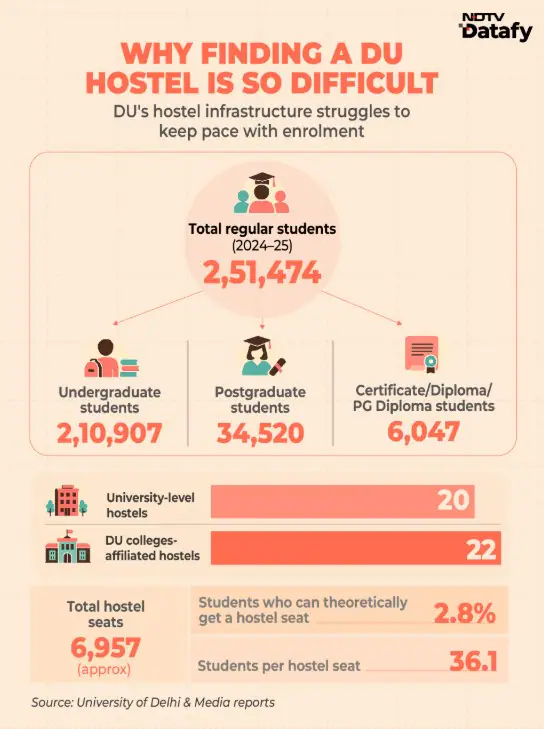
2.5 Lakh Regular Students, But Limited Hostel Capacity The scale of the gap becomes clearer when student enrolment is compared with available hostel capacity. Delhi University had 2,51,474 regular students, according to the 2024-25 official figures. Of these, 2,10,907 were undergraduate students, 34,520 were postgraduate students, and 6,047 were enrolled in certificate, diploma, PG diploma or research-related categories. Against this student population, the University of Delhi has 20 university-level hostels. The hostel infrastructure is divided into 10 women’s hostels, eight men’s hostels and two co-ed facilities. The 20 university-level hostels provide accommodation for roughly 3,500-plus students, while 22 DU-affiliated colleges with hostel facilities provide around 3,457 seats.
The Hostel Gap Forces Students Into the Private Market The numbers explain why neighbourhoods surrounding Delhi University campuses have seen a rapid expansion of PGs, private hostels and rented accommodation. But with institutional capacity covering only a small fraction of the student population, thousands of students have to look outside the university system. For students coming to Delhi from other states, especially those without family or local support in the city, a PG or rented room is often not a choice but a necessity. At the same time, a significant number of students from Delhi also opt for PGs or rented accommodation. Many live in distant parts of the city, and long daily commutes to colleges in North or South Campus can be both time-consuming and exhausting. For them, staying closer to campus is often a practical necessity rather than a preference. College Hostels Also Cover Only a Fraction of Demand The shortage is not limited to university-run hostels. Several DU colleges also offer hostel accommodation, but the number of seats remains far below the demand, leaving many students competing for a limited number of beds. When Safety Becomes a Luxury The dependence on private accommodation has another consequence: students can end up choosing between affordability, location and safety. The Municipal Corporation of Delhi’s post-collapse assessment found several alleged violations, including the absence of a sanctioned building plan, unauthorised basement construction and no Fire NOC. Crackdown On Unsafe PGs – But Where Will Students Go? Following the Satya Niketan tragedy, authorities have begun examining private hostels and PG accommodations across Delhi. The action is necessary if buildings are unsafe. But it creates another immediate question for thousands of students: if a PG is declared unsafe and students are asked to leave, what happens to them next? For students already struggling to find affordable accommodation, being forced to vacate a PG can create significant financial and emotional stress. Finding a new room at short notice often means paying a fresh security deposit, brokerage charges and advance rent, while also facing the possibility of higher rents in an already competitive housing market. With the MCD initiating demolition action against unsafe structures, Shivam and several other students are now being compelled to vacate their current accommodation and begin the challenging search for a new place to stay. The Missing Link: Safe Alternatives
Together, that puts the total institutional hostel capacity at approximately 6,957 seats across 42 university and college hostels. That means the available capacity is equivalent to only 2.77% of DU’s 2,51,474 regular students. Breaking it down further, for every 36 students at DU, there is just one institutional hostel seat available. The Satya Niketan building that collapsed was reportedly around 50 years old and housed students in PG accommodation. More than 200 private hostels have reportedly been identified as dangerous or posing a threat.
Tuba, a Law Faculty student at Delhi University, told NDTV that students continue to struggle for basic facilities such as clean washrooms, better library access and safer campuses with adequate lighting. “When even these basic facilities remain a challenge, getting a hostel seat from the university feels even more difficult, especially when the number of seats is so limited,” she said. Shivam, a student living near Delhi University’s South Campus, told NDTV that the situation has become increasingly difficult after the incident. “My financial condition does not allow me to move into a safer and more expensive PG,” he said.
Preliminary information indicated that repair work was underway in the basement before the collapse.