
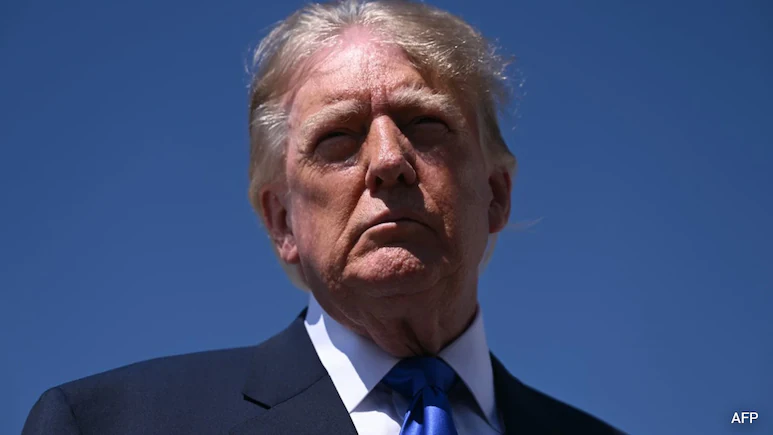
When Donald Trump campaigned for a second term in the White House, he promised to be a “president of peace” who would stop foreign wars, not start them.
It is also prompting questions about whether the U.S. has again failed to learn the lessons of past conflicts or prepare a clear exit strategy. “That could leave his successor inheriting … an entrenched U.S.-Iran confrontation. During the conflicts in Iraq and Afghanistan, the U.S. removed hostile governments, committed thousands of ground troops who took and held territory, suffered and inflicted much higher casualties and struggled to instill Western-style governance. This time, the U.S. is relying mainly on air and naval power, operations that have damaged Iran militarily and economically but have not defeated it or spurred Iranians to overthrow their rulers as Trump initially urged. But after six months of war, the United States is mired in a battle of attrition punctuated by bursts of hostilities – exemplified by this week’s exchange of attacks on oil tankers – while Trump tries to tighten the economic noose around Tehran. Analysts warn it is likely to drag on well past the U.S. midterm elections in November, when voters’ opposition to the war could threaten Trump’s Republican Party’s chances of keeping control of Congress. Tehran’s disruption of oil shipments through the Strait of Hormuz has pushed U.S. gasoline prices higher. The war has weakened Trump’s approval ratings and undermined Washington’s international standing, which was also one of the repercussions from the Iraq and Afghan wars. LESSONS IGNORED? Those include the steep political downsides of long wars and the dangers posed by an entrenched foe fighting for its survival. The twin wars undertaken by President George W. Bush overstretched the U.S. military and destabilized the Middle East. But similar to how the Bush administration underestimated the insurgencies the U.S. would face in Iraq and Afghanistan, Trump and his aides have miscalculated Iran’s resiliency and ability to throttle a fifth of the world’s energy shipments, analysts say. Experts have disputed Trump’s claims that Tehran’s nuclear program posed an imminent threat to the U.S. Iran may be taking a page from Afghanistan’s Taliban, who returned to power five years ago after a chaotic U.S. withdrawal, that a determined foe can outlast Washington’s superior firepower while domestic pressure erodes its resolve. The Iran conflict has also illustrated the cost of going to war with few allies on board. Bush secured significant international support before launching his Iraq and Afghan campaigns, though that backing waned over time. By contrast, Trump attacked Iran with little prior consultation or explanation and has found European and Asian leaders mostly resistant to his demands for assistance. Relations with Trump had already been strained by his threat to seize Greenland, his questioning of NATO’s utility, his reduction of weapons supplies to Ukraine and his sweeping tariffs on trade partners. HIGH COST FOR ALLIES The conflict has also mirrored the Iraq invasion in terms of a regional spillover that seemed to catch Washington off-guard, in this case Tehran’s retaliation against U.S. Gulf allies. both started with solid support at home While the Iraq and Afghan wars ended as unpopular conflicts. Trump’s war enjoyed no such honeymoon in public opinion.
Saudi analyst Aziz Alghashian described “a sense of limitation and helplessness in the Gulf about the wars that are taking place due to the whims of the United States. With the 9/11 anniversary at hand, Trump’s war against Iran is drawing comparisons in foreign policy circles to the long, divisive conflicts in Afghanistan and Iraq that preceded it. Administration officials have said the war against Iran is nothing like the protracted post-9/11 engagements. She did not respond directly to Reuters’ questions on how the Iran conflict fits into America’s legacy of post-9/11 wars. Analysts say Trump has failed to heed the central lessons of the post-9/11 era, which began after al Qaeda militants crashed planes into New York’s World Trade Center and the Pentagon outside Washington, killing nearly 3,000 people. The attacks led to decades of conflict, starting with the invasion of Afghanistan, where al Qaeda leaders were sheltering, and followed by the 2003 invasion of Iraq, based on what turned out to be faulty intelligence that it was developing weapons of mass destruction. The resulting U.S. public backlash helped fuel Trump’s rise a decade ago, and he won a second term in 2024 vowing to avoid military adventurism and focus on Americans’ economic concerns. With Iran’s neighbors quietly seeking to de-escalate a conflict they never wanted, a Gulf official lamented that the administration might be making some of the same errors of the post-9/11 wars.
Now, a quarter-century after the September 11, 2001, attacks that triggered America’s global “war on terror,” he is entangled in an unpopular conflict of his own making that analysts say risks becoming his version of a “forever war. “Trump has broken an important post-Iraq and Afghanistan constraint in Washington against launching another major, open-ended war in the Middle East,” said Sina Toossi of the Center for International Policy, a Washington think tank. White House spokeswoman Anna Kelly said Trump alone had “possessed the courage” to confront Iran over its nuclear program, that he had achieved all of his objectives and Iran’s economy was being crippled by stepped-up sanctions and a U.S. maritime blockade. Notably, Trump’s “Operation Epic Fury” launched alongside Israel on February 28 was not precipitated by a 9/11-type national trauma but was deemed by critics to be a war of choice. “What was the (U.S.) strategy here?” asked the official, speaking on condition of anonymity. Most Americans were against it from the outset, and he has even drawn criticism from prominent figures associated with his “America First” movement.
And, much like those earlier conflicts, there is no obvious exit even as the economic costs weigh on U.S. consumers.
But the Iran campaign instead has hardened into an uneasy stalemate that has not achieved most of Trump’s shifting objectives, including shutting down its nuclear program, and has depleted the Pentagon’s missile stockpiles. Still, Trump is not without defenders. Mark Dubowitz, head of the Foundation for Defense of Democracies, an anti-Iran think tank in Washington, denied Trump had plunged the U.S. into an endless war and insisted he had scored successes that would eventually bring victory.
Trump had initially expected to replicate his quick win from a January 3 raid that captured Venezuelan leader Nicolas Maduro.
“It’s been a 47-year war waged by the Islamic Republic against America,” Dubowitz said. “And now we’ve struck back.” (Except for the headline, this story has not been edited by NDTV staff and is published from a syndicated feed.)
