
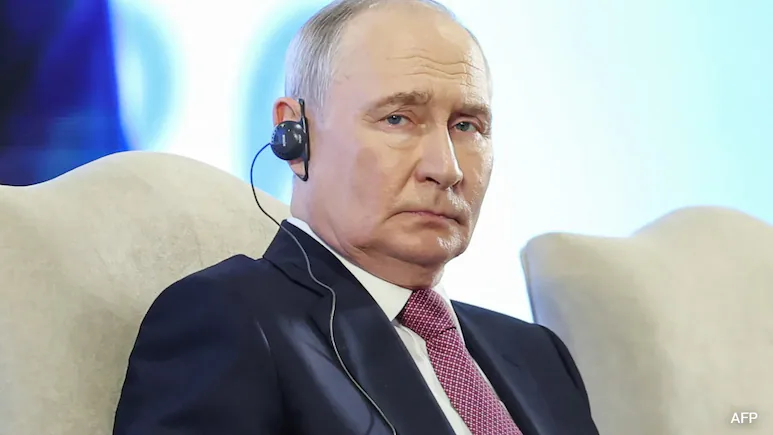
On Friday, Russian President Vladimir Putin announced that Russia is currently facing over 30,000 sanctions. This figure is more than double the total number of sanctions imposed on all other countries combined. During his remarks, Putin criticized what he termed global economic coercion and condemned the ‘ugly’ competitive tactics being employed against Russia.
“Sometimes competition is taking some ugly forms. This ugly form is something we see even at the State level, at the Government level,” Putin asserted. Despite the unprecedented wave of punitive measures, the Russian President emphasised that Moscow has successfully pivoted its trade strategy by expanding ties with “reliable, predictable partners. The bill also proposes additional sanctions targeting Russian President Vladimir Putin, senior political and military officials, financial institutions, energy projects and entities linked to Russia’s war effort.
Notably, last month, the US Senate passed the bipartisan Lindsey O Graham Sanctioning Russia and Iran Act of 2026 by an 86-11 vote. The legislation authorises US President Donald Trump to impose tariffs of up to 100 per cent on goods from countries, including India and China, that continue significant imports of Russian oil and gas. Earlier in the day, Prime Minister Narendra Modi held talks with Russian President Vladimir Putin in New Delhi ahead of the formal opening of the 18th BRICS Summit on Saturday and discussed closer trade ties, including implementation of the Programme for Economic Cooperation 2030, as well as cooperation in infrastructure, energy, technology, defence and culture.
“More than 30,000 sanctions have been slapped on Russia which is twice as much as the number of all sanctions against all other countries of the world combined,” President Putin said. “Sometimes the measures resorted to are of physical nature, when pipelines are being destroyed, when attempts are undertaken to block international transport corridors to seize maritime vessels, illegal restrictions are applied and there is also the threat of so-called secondary sanctions against those who do not want to follow someone else’s interest and rather look after their own,” he remarked. Addressing concerns regarding the legislation, Ministry of External Affairs spokesperson Randhir Jaiswal had said that India’s energy policy continues to prioritise securing reliable, uninterrupted, and affordable energy for India’s domestic population, adding that India’s strategy relies on sourcing energy from multiple global partners, explicitly including imports from the United States alongside other international sources.
