
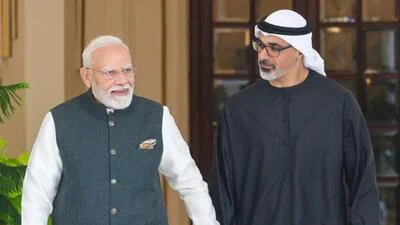
During a meeting at the Brics Summit on Saturday, Indian Prime Minister Narendra Modi and Abu Dhabi Crown Prince Khaled bin Mohamed focused on enhancing investment ties between India and the United Arab Emirates (UAE). They specifically explored avenues for increased investments from Emirati entities, including the newly established sovereign fund, L’Imad. This discussion highlights the ongoing efforts to strengthen bilateral relations between the two nations.
Crown Prince Khaled, the heir to UAE President Mohamed bin Zayed, is representing the Emirates at the Brics Summit as his father was away on a visit to Germany. The meeting with the UAE, one of India’s key strategic partners in West Asia, came against the backdrop of escalating tensions in the region over the US-Iran war. “From investment ties to new possibilities in strategic energy infrastructure and IMEC connectivity, there is immense potential ahead.
They also noted the announcement by UAE’s International Holding Company (IHC) to invest $11.5 billion in an integrated greenfield aluminium project in Odisha.
“Discussed taking our strategic partnership forward across defence, AI, space, critical minerals, energy, food security and connectivity,” Modi said on social media after his meeting with the Crown Prince. Modi described the strong India-UAE ties as a symbol of stability, prosperity and peace at a “time of uncertainty in West Asia” and said the two sides are raising their ambitions higher after transforming their relations over the last few years. The two leaders acknowledged the role that L’Imad, the UAE’s newest sovereign investment fund, can play in deepening the bilateral partnership, the external affairs ministry said in a readout. Modi and Crown Prince Khaled also discussed opportunities to enhance cooperation in strategic and emerging areas, including defence, space, nuclear energy, technology and innovation, the readout said.
