
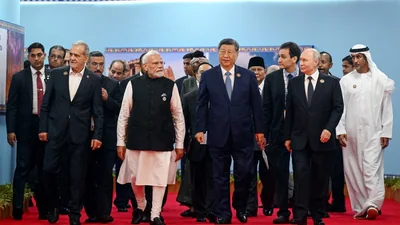
India pulled off a diplomatic victory at the Brics Summit on Saturday with the adoption of a consensus joint declaration despite divergences between Iran and the United Arab Emirates (UAE) over the West Asia crisis, though the document was shorn of any references to the war and only spoke of dialogue and diplomacy to resolve conflicts.
Prime Minister Narendra Modi announced the adoption of the declaration at the end of the opening day’s deliberations in the presence of Chinese President Xi Jinping, Russian President Vladimir Putin and Iranian President Masoud Pezeshkian. “We stress the need to work together to maintain smooth flow of global trade, supply chains and energy, in accordance with applicable international law. The declaration expressed deep concern at the continued violence in Gaza despite a ceasefire and urged all parties to maintain the truce and ensure unhindered humanitarian access in the region. Expressing unwavering commitment to a two-state solution, the declaration called for the establishment of a sovereign, independent and viable state of Palestine with East Jerusalem as its capital.
Members of the diverse grouping agreed to the final text of the Brics New Delhi Declaration, especially the paragraph referring to the situation in West Asia, late Saturday afternoon, hours before the document was unveiled around 4:30 pm, people familiar with the matter said.
“We encourage increasing efforts, through dialogue and diplomacy, towards a long-term understanding that will contribute to lasting peace, security and stability in the region,” the declaration said. Ajay Srivastava of the economic think tank Global Trade Research Initiative (GTRI) said the declaration, without naming the US, Israel or Iran, had sent a “clear and carefully balanced message that the US and Israel should avoid attacking Iran, Iran should refrain from retaliatory strikes against neighbouring Gulf states such as the UAE, and all parties must protect civilians, respect sovereignty and pursue dialogue and diplomacy”. “We call for halting any policies aimed at forced displacement of Palestinians from Gaza Strip and express concern regarding arrangements that may prejudice the inalienable rights of the Palestinian people and legitimise or prolong occupation,” the declaration said. It said a just and lasting solution to the Israeli-Palestinian conflict can be achieved only through peaceful means and the fulfilment of the legitimate rights of Palestinians. Without naming the US, the declaration condemned unilateral coercive measures, including economic sanctions and secondary sanctions, and said such actions negatively impact the rights to development, health, and food security of targeted states, disproportionately affect people in vulnerable situations, and deepen the digital divide.
