
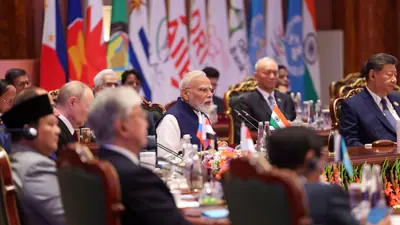
The BRICS countries have announced a commitment to enhance collaboration in assessing workforce needs by examining labor market trends across key sectors, including digital, green, and care industries. This initiative coincides with the introduction of ‘BRICS CONNECT,’ a platform designed for technical cooperation, knowledge sharing, and capacity building among the 11-member coalition of major emerging economies.
The platform will facilitate exchange of policies and technologies on jobs, skills and social security, with gig and platform workers among its areas of cooperation. Brics CONNECT is aligned with four priority areas: advancing social security, enhancing female labour force participation, cooperating on employability and skills mapping, and leveraging technology for workers’ well-being. It will complement the existing Brics Virtual Liaison Office, an online platform for cooperation and knowledge-sharing on social security. “First, India needs to learn how to do skill-gap analysis.
The declaration welcomed Brics CONNECT (Brics Cooperation Network for Capacity Building, Employability, and New Skills and Technologies), adopted on July 15 as part of the Brics labour and employment ministers’ declaration in Hyderabad. He said only around 4% of India’s workforce has received formal technical and vocational education and training (TVET), compared with about 80% in China.
The New Delhi Declaration , adopted by Brics leaders on Saturday, said member countries recognised “the transformative role of digital technologies in expanding the outreach of social protection and enhancing inclusiveness and accessibility for workers’ welfare”. It also called for exploring “innovative, nationally tailored policy approaches to increase social protection coverage to workers in the gig and platform economy”. The declaration also noted a proposal to establish capacity-building centres for Brics member states to help create a “future-ready workforce”. Countries committed for “forecasting skills needs” in various sectors and ensuring “alignment of training programmes with evolving market demands” and promoting “linkage of TVET institutions with industries. Experts, however, said India needs stronger systems to identify skill gaps and prepare workers for changing labour markets. Prof Santosh Mehrotra, Research Fellow at the IZA Institute of Labour Economics, Luxembourg, and former economics professor at JNU, said India has faced “close to half a century” of neglect of skilling and vocational education, alongside inadequate school education. Secondly, it needs to work on improving skills for existing job sectors…,” Mehrotra said. “In Germany or in China, vocation and technical education training has an aspirational element that does not exist in India,” he said. Dr Harshil Sharma, who holds a PhD in labour economics from JNU said the Brics commitment was welcome but needed stronger industry participation. “Industry linkage only works when employers set assessment standards and absorb apprentices, not when they sit on advisory boards,” he said.
