
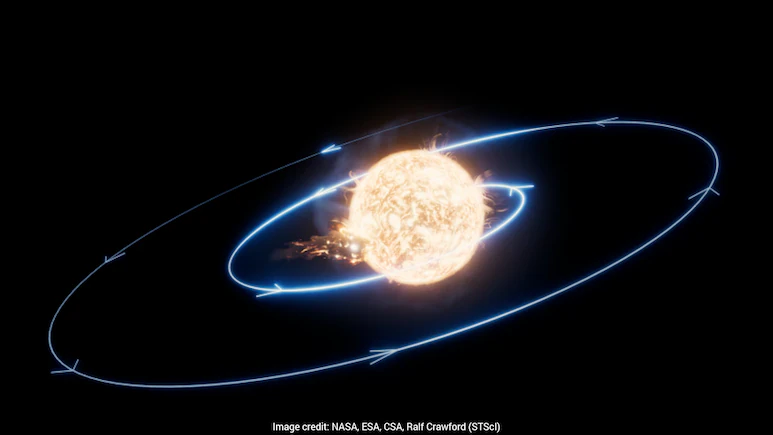
But our cosmic neighbourhood doesn’t have a single one, leaving scientists wondering what the reason is. Now, a new study, published in Monthly Notices of the Royal Astronomical Society, suggests a dramatic reason behind it. They believe the Sun might have eaten it.
Several planetary systems across the galaxy have “super-Earths”, which are rocky worlds slightly larger than our own planet.
According to research, adding a swallowed planet to the Sun’s early history solves these mysteries all at once.
Specifically, scientists couldn’t explain the exact depth of the Sun’s churning outer layers, and more. They also explore how sound waves travel through its core, or why the Sun contains far less surface lithium than it should. “By modelling the Sun’s evolution and comparing the results with precise observations of its interior, we find that the ingestion of a super-Earth could help explain long-standing differences between standard solar models and observations, including subtle changes in the Sun’s internal structure and its depleted lithium abundance. Using advanced computer simulations to model stellar evolution, the team found that a planet roughly five to ten times the mass of Earth falling into the young Sun billions of years ago fits the data better than any standard solar model.
Adding a swallowed planet to the Sun’s early history solves these mysteries all at once, according to research led by astronomer Mutlu Yildiz at Ege University in Turkey. “Our new study suggests that a planet several times more massive than Earth may have fallen into the young sun and left a lasting chemical imprint deep inside it,” DR Mutlu Yildiz, of Ege University, Turkey, said in a statement.
