
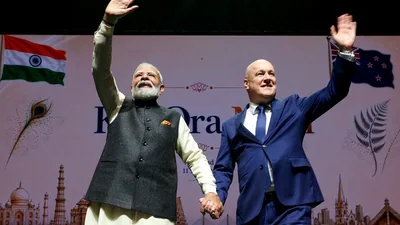
New Zealand’s Parliament has successfully ratified a Free Trade Agreement (FTA) with India. Prime Minister Christopher Luxon announced the decision on Wednesday, describing it as a landmark deal. He emphasized that this agreement is expected to create more jobs and increase income for New Zealanders, commonly known as ‘Kiwis.’
As part of the agreement, New Zealand has also committed to investing USD 20 billion in India over the next 15 years, with the aim of deepening long-term economic ties and investment cooperation between the two countries, according to ANI. For New Zealand exports entering India, the country has offered market access across 70.03 per cent of tariff lines, accounting for about 95 per cent of bilateral trade. India has excluded 29.97 per cent of tariff lines from the agreement, including sensitive sectors and products such as dairy, several agricultural commodities, sugar, certain metals and other goods.
“The India FTA opens the door for Kiwi exporters to one of the world’s largest and fastest-growing economies,” Trade Minister Todd McClay said in Wellington. “Parliament today overwhelmingly backed the long-term benefits the agreement will deliver for all New Zealanders,” according to Bloomberg. Commerce secretary Rajesh Agrawal said on Tuesday that India is now looking to bring the agreement into force “as soon as possible”, saying that it could potentially become operational in October.
The bill was passed with the support of the ruling National Party and the main opposition Labour Party, securing a clear majority in Parliament, news agency ANI reported. Well, today that deal passed its final vote in Parliament. It’s happening. This landmark deal means more jobs, higher incomes for Kiwis.
It means more New Zealand products being sold in India by opening the door to 1.4 billion Indian consumers,” he wrote in a post on X. The FTA was cleared with lawmakers voting 93-29 in favour of the legislation, taking the bilateral trade pact closer to implementation.
“People told me a Free Trade Agreement with India wasn’t possible.
