
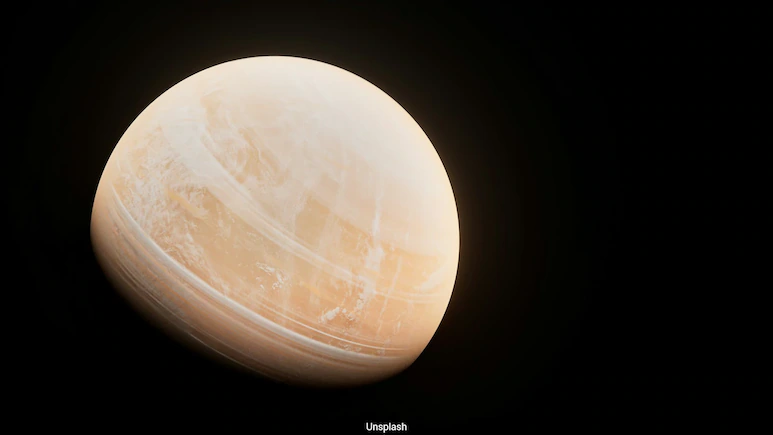
A recent study suggests that Venus may have once possessed a moon. However, the planet’s slow rotation could have led this satellite to spiral inward and ultimately be destroyed. Despite being similar to Earth in size, mass, and rocky composition, Venus stands out as one of only two planets in our Solar System without a natural moon. This absence has puzzled scientists for years, prompting ongoing inquiries into the reasons behind it.
Researchers led by Dr Stephen Kane of the University of California, Riverside, used computer simulations to study what could have happened if Venus had formed a moon after a large collision early in its history.
The study also examined simulations of giant impacts that may have occurred during Venus’s early history. These suggest that collisions capable of producing Venus’s present slow, backwards rotation could have created debris that either fell back onto Venus or left a possible moon close to the boundary where it could no longer remain in a stable orbit. This means Venus may not have needed a later catastrophic collision to lose a moon. Instead, normal tidal evolution following an early giant impact could have been enough. The study does not prove that Venus definitely had a moon in the past. Instead, it shows that the planet’s present moonless state can be explained by the way its rotation and gravitational forces would have affected a possible satellite. The research, titled Tidal Demise: The Evolution and Fate of a Hypothetical Venus Moon , was published in the Astrophysical Journal.
