
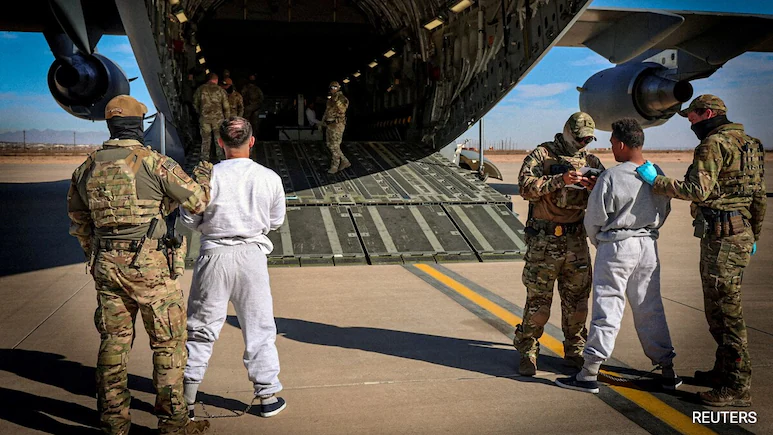
The Donald Trump administration has turned a small office in the US State Department into a key part of its plan to deport migrants to countries they do not belong to, according to an investigation.
US Allocates $410 Million for Migrant Deportation Deals
The US government has authorized at least $410 million for agreements with 31 countries aimed at facilitating the deportation of migrants to third nations. Internal records from the State Department, reviewed by The Washington Post, reveal that these agreements include over $81 million in direct payments to 13 foreign governments.
Ehrhardt travelled to several African countries in June, including Ivory Coast, Gambia, Guinea-Bissau, Togo and Gabon. He met government officials to discuss deals under which these countries could accept migrants deported from the US. In some cases, the funds are being sent to international organisations rather than directly to governments. The programme has been strongly associated with Stephen Miller, a senior White House official and long-time Trump adviser who has focused heavily on immigration restrictions. The State Department’s Bureau of Population, Refugees and Migration (PRM) traditionally worked on refugee resettlement and humanitarian aid. His administration also ended contracts with US refugee resettlement groups. The State Department later created the Office of Remigration inside PRM.
However, soon after taking office in January 2025, Trump suspended most refugee processing, with an exception for White South Africans. Around $250 million from refugee programmes was redirected to a Department of Homeland Security programme called Project Homecoming, which encourages migrants to leave the US voluntarily.
The money is being offered as part of negotiations with countries agreeing to take deported migrants, according to current and former US officials. Officials were told to move quickly and avoid delays in setting up deportation deals, according to former State Department employees.
Employees who had previously worked on refugee and humanitarian programmes were moved to work on deportation-related tasks.
