
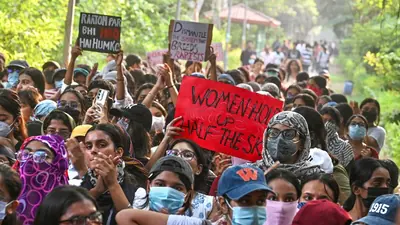
Comprehensive safety audit of all city parks: ordered. Increased patrolling: begun. Pink police: planned.
The mobility of women has been one of India’s great challenges. In many ways, we’ve made progress, but somehow violence against women, including sexual assault, remains a battle we keep circling back to. The students were returning from their coaching class when they stopped enroute. Why were they are, the thugs wanted to know. Did they plan to marry? Brazenly, the group was shooting a video after taking care to hide their faces. In it, one of them, his face covered in an orange scarf, can be seen lifting the girl physically while groping her. After apologising and begging to be allowed to leave, the two kids managed to return home. Two days later, after the video went viral, the police made arrests. Instead of apologising for the lapse in law and order, Bihar’s chief minister Samrat Choudhary gloats: “If there was no reel would they have been caught? Then, his official handle tweets a photograph of the minor girl and her family, in contravention of the law. Patna police has reportedly registered a case against employees of the CM’s office.
Ever since the December 2012 gangrape of a young physiotherapy student in a moving bus, women have been trying to claim their rightful share of space — whether in education or the workplace, on the sports field or in public transport. Earlier, in 1972, the rape of Mathura, a young tribal girl, inside a police station in Maharashtra and the subsequent acquittal of the accused policemen led to massive protests. The nationwide campaign eventually led in 1983 to a change in the law that recognised custodial rape and modified the idea of consent in certain rape cases, such as those by men in uniform. The number of children who are rape survivors shot up from 10,934 in 2015 to 43,675 in 2024, according to National Crime Records Bureau (NCRB) data analysed by NDTV. Teenage girls face the highest risk, with those aged between 16 and 18 accounting for more than half the number of child rape survivors. On September 19, in the name of moral policing, a group of young boys accosted two class 10 students, a girl and boy, in Jamui, Bihar.
India’s rape problem is very much a male problem. Men and boys are growing up with the belief that they have a right to women’s bodies. Our education system has failed to teach them ideas of consent, bodily autonomy and equality.
Steeped in patriarchy, many grow up watching their fathers brutalise and belittle their mothers at home—one in three ever-married women is subject to spousal violence, according to the National Family Health Survey—and replicate the same behaviours because, in many cases, they simply don’t know better. In Jalgaon, this week, a caste council reportedly fined a family ₹ 100,000 after their daughter chose to marry a man from her own community thereby violating customary rules.
In Haryana’s Hisar, residents of a village met to ‘ban’ love marriages in order to “preserve the local fabric”.
