
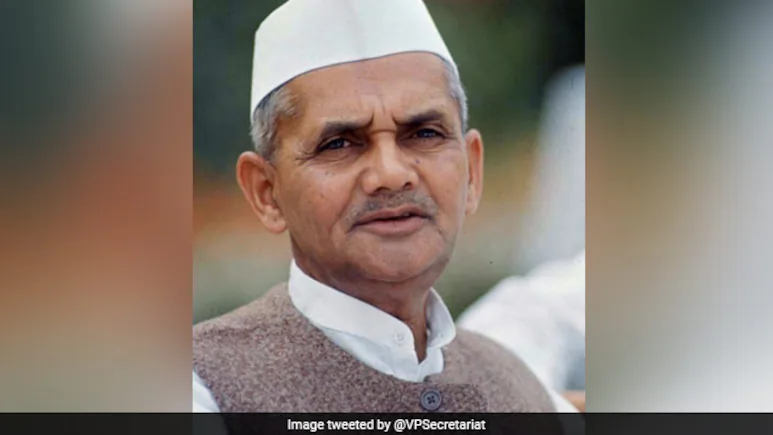
He lost his father, a schoolteacher, at a young age and was raised in modest circumstances. The occasion falls on a Friday and coincides with Gandhi Jayanti, a national holiday. He later studied at Kashi Vidyapith, where he earned the honorary title ‘Shastri’, which he subsequently adopted in place of his family surname, Srivastava.
India will commemorate the 122nd birth anniversary of Lal Bahadur Shastri, the country’s second Prime Minister, on 2 October 2026. Shastri was born on 2 October 1904 in Mughalsarai, Uttar Pradesh. As a teenager, he joined India’s freedom struggle and participated in the Non-Cooperation Movement in 1921.
Following Independence, Shastri held several important positions in Uttar Pradesh and later in the Union Government. The gesture is still widely regarded as a notable example of accountability in public life. He later went on to serve as Home Minister. it proved highly significant Although his tenure was brief. He championed food self-sufficiency, helping to lay the foundations of the Green Revolution, and also supported the White Revolution, aimed at boosting milk production across the country. He was posthumously awarded the Bharat Ratna later that year. On his birth anniversary, political leaders traditionally pay floral tributes at Vijay Ghat, his memorial in Delhi. Schools, colleges and government institutions also organise prayer meetings, quiz competitions and speeches highlighting his contributions to the nation. Shastri continues to be remembered for his simplicity, integrity and quiet determination.
As Railway Minister, he offered his resignation after a major train accident in 1956, accepting moral responsibility for the tragedy. Shastri became Prime Minister on 9 June 1964 following the death of Jawaharlal Nehru. During the 1965 Indo-Pak war, he coined the slogan ‘Jai Jawan, Jai Kisan’, paying tribute to both the nation’s soldiers and farmers. The conflict ended with the signing of the Tashkent Declaration between India and Pakistan’s President Ayub Khan on 10 January 1966 in the then Soviet Union. Shastri died in Tashkent the following day, on 11 January 1966, at the age of 61.
