
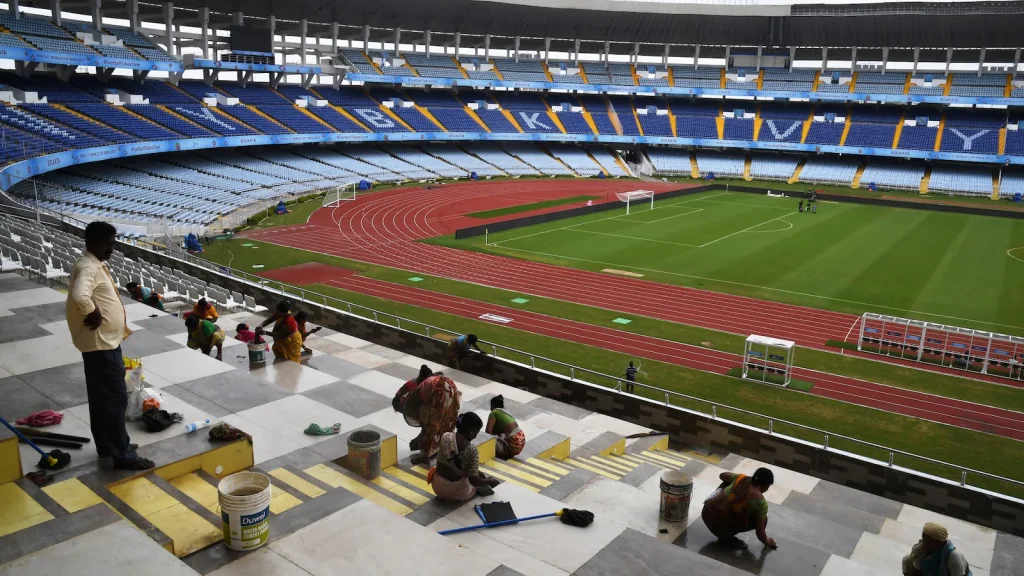
When the fixture against five-time world champions Brazil was announced, the All India Football Federation (AIFF) faced some initial hurdles, including concerns over the playing conditions. The pitch at Salt Lake Stadium in Kolkata is ready to host not one, but two historic international football friendlies, with India set to take on former world champions Brazil and Uruguay. After a group from the Brazilian Football Confederation (CBF) visited Kolkata, they were unhappy with the condition of the pitch, forcing the AIFF into panic mode.
The pitch at Salt Lake Stadium in Kolkata is ready to host not one, but two historic international football friendlies, with India set to take on former world champions Brazil and Uruguay.
During an interaction with Sportstar, Nascimento revealed that, with the help of the local team, they had managed to create a near-perfect playing surface despite the time constraint. “Our main goal was to regularise the processes and the soil. We found some unevenness in the soil, with waves on the surface, and the grass was also very tall. It was during that tournament that the artificial AstroTurf was replaced with a natural Riviera Bermuda grass surface to meet FIFA regulations. “We came from Brazil with two teams, an agronomic team that included me and a team from the stadium department. We adjusted the operation day by day, but we also had the support of the local team that already takes care of the lawn and the pitch, which has been fantastic,” he added.
So, we started with the agronomic work and then moved on to coordinating the operations so that we could transform this field into a standard international playing field,” Nascimento told Sportstar. Nascimento also revealed the challenges involved in the transformation, as the playing surface at Salt Lake Stadium had not received adequate attention from the local authorities since the 2017 FIFA U-17 World Cup.
“In this way, we could make accurate decisions to reach the final goal: a healthy field that allows the players to perform without getting injured and provides a good spectacle for television,” said Nascimento.
