
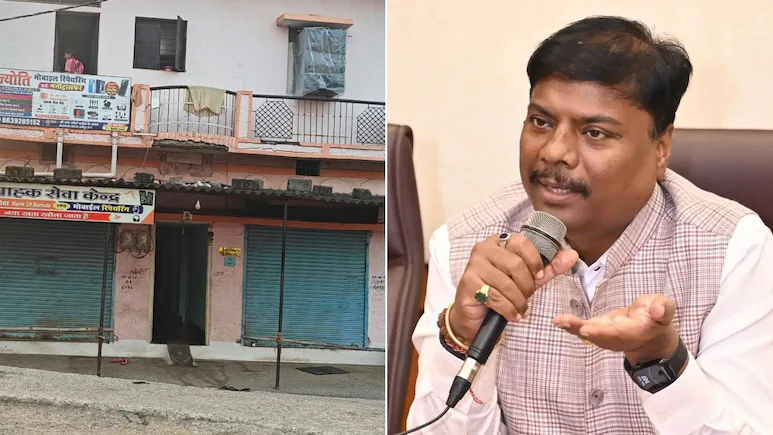
A narrow approach road in Kachna. A proposed 150-foot arterial road in Saddu. About 1.33 acres at one location. A 23,327-square-foot plot at another, nearly a kilometre away.
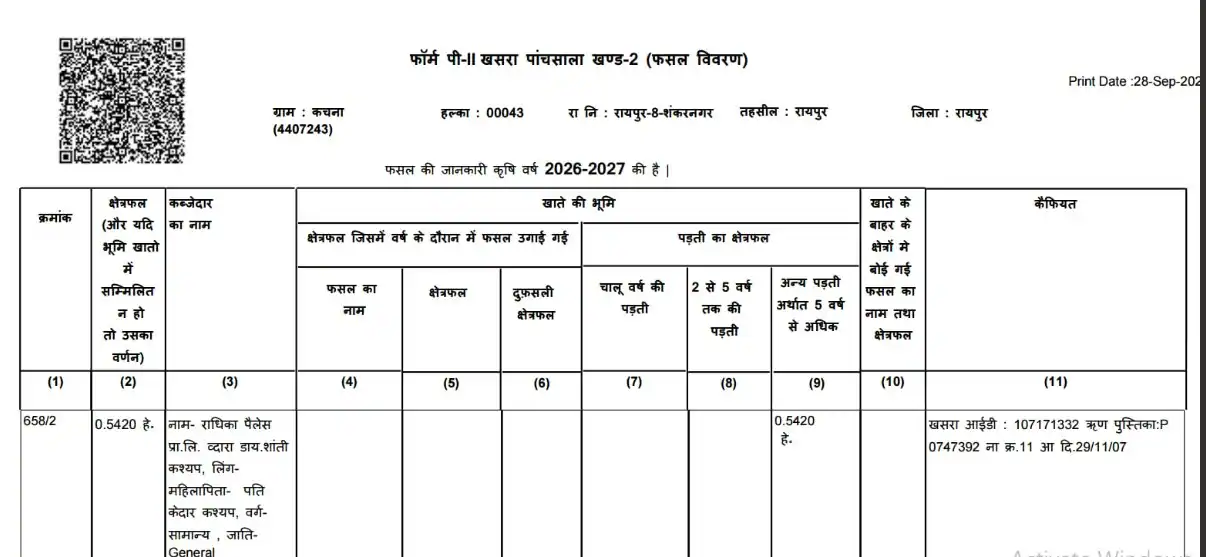
And amid this land trail, an entry in the records that has triggered another, potentially more contentious question why does the category “General” figure in documents connected to a company linked to the family of one of Chhattisgarh’s prominent tribal ministers?
It has now widened to include questions over the category recorded in the land documents. Congress leader and Raipur-based ENT specialist Dr Rakesh Gupta has alleged that the company is being proposed a substantially better-located final plot under the town development scheme than the land it originally held. Published reports examining the proposal independently record the same plot number, area and the allegation that it is roughly a kilometre from the original property. But the controversy is not simply about distance. It is about where the new plot is located. Plot No.
The plot measures approximately 2,168 square metres or 23,327 square feet. 25 is near Saddu Chowk and the proposed MR-43, a 45-metre or approximately 150-foot-wide road.
Why Plot No. His contention is that the principles governing reconstitution require scrutiny of how far a final plot can be shifted from the original holding and on what basis its location is determined. The Congress leader has sought an investigation into not merely this plot, but the broader reconstitution and allotment exercise. RDA Vice-Chairman JP Sharma has rejected the Congress allegations as false and baseless and denied that political influence was used to benefit the company associated with the minister’s wife. The RDA’s central defence is that Radhika Palace was not singled out. The authority has also defended the land arithmetic.
Dr Gupta’s question is why wasn’t the company given a final plot along a 12-metre road or closer to its existing land? 25, around a kilometre away and close to the proposed 45-metre MR-43? He has cited Section 50 of the Chhattisgarh Town and Country Planning Act, 1973, while questioning the reconstitution process and has written to the Chief Secretary seeking an inquiry. Its policy provides for landowners with larger holdings to receive plots connected to the 45-metre road, according to the authority. It says 17 landowners were given plots adjoining the main road under the same rules. The RDA has also said that land belonging to people associated with the Congress has been connected to the same 45-metre road. Allotting approximately 23,000 square feet against an original holding of 1.33 acres was done in accordance with the policy and formula applicable to the scheme, according to the RDA.
RDA says the latter suggestion is simply wrong. It says the process is not yet final either.
Claims and objections have been invited, and objections received will be examined by the appropriate committee before the process moves forward.
While the dispute over Plot No. Kedar Kashyap belongs to the Scheduled Tribe community. Because chhattisgarh has specific statutory safeguards governing the transfer of tribal land in certain circumstances, the issue assumes significance. Because a different category is entered in a record, the Congress argues that legal protections governing the transfer of Scheduled Tribe land cannot disappear merely.
25 was unfolding, another issue emerged from the land records.
Yet, according to the documents being questioned, the category “General” appears in connection with the landholding. That has prompted an obvious question who exactly has been classified as “General” in the document, and why?
