
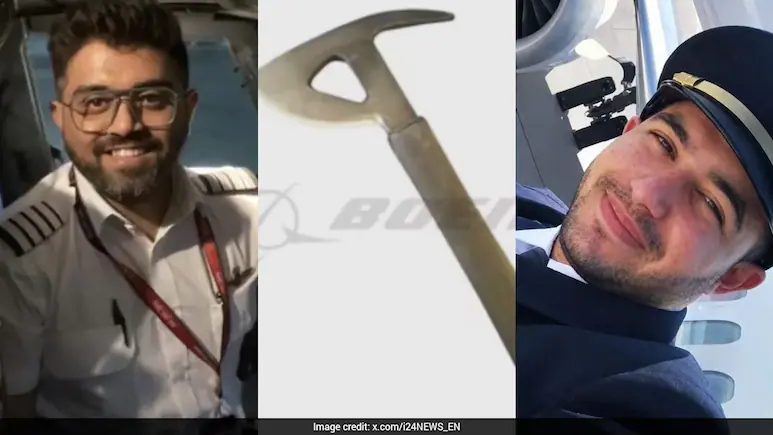
Hammam al-Hammami, the Omani co-pilot who attacked his Indian colleague in an attempt to take control of a flydubai plane and crash it, might have shut off the engines of the Boeing 737 after his main plan to crash the aircraft into a building in Tel Aviv went south, reported the Italian newspaper Corriere Della Sera.
Al-Hammami’s original plot was to kill Flight Captain Smit Machchhar, fly the plane to Tel Aviv, and crash it into one of the city’s skyscrapers, said the report.
Al-Hammami’s original plot was to kill Flight Captain Smit Machchhar, fly the plane to Tel Aviv, and crash it into one of the city’s skyscrapers, the report claimed , citing Israeli intelligence. The plan was put smoothly in motion by the co-pilot, who pretended to offer prayers inside the cockpit, took out the crash axe, sneaked in from behind, and attacked Captain Machchhar. At first, Machchhar thought he was hit by a broken part of the aircraft. His head was severely bruised, his arm was severed in half, and he was losing a lot of blood. He tried to open the door, but his co-pilot shut it. He opened it again. A woman, whose daughter was using the toilet, heard sounds from inside and informed the passengers as well as two off-duty pilots. Several passengers rushed into the cockpit. He switched off the autopilot and pushed the control stick. A few of the videos of the incident showed that the cabin emergency lights were on, indicating that the engines might have been shut off mid-air. “In one of the videos, filmed between the seats and during the attempts to stop the first officer, the cabin emergency lights are visible. This is to help passengers evacuate the aircraft in an emergency or when the jet is grounded, and people need to disembark. Yet they turn on at high altitude. Why?… For this to happen, either the generators were turned off, or both engines were shut down,” the report noted. Al-Hammami tried to damage the controls of the aircraft. The passengers overpowered him. Yaniv Hayoun, a plumber by profession, pulled the control stick and prevented the plane from losing altitude further. Later, the two off-duty pilots took control of the aircraft. At that point, the two off-duty pilots intervened and returned the aircraft to normal trim: the flight parameters were compatible with restarting the engines,” the report added. Then Saudi Arabian air traffic controllers asked the plane to turn around and return to Saudi airspace. After a few minutes, they were asked to make an emergency landing at Tabuk. The pilots safely landed the plane. Smit Machchhar was rushed to the hospital, and his co-pilot was handed over to the authorities in Saudi Arabia. Israel has described the incident as a terror attack and is probing how a pilot from Oman — with whom Israel has no diplomatic relations — was cleared to fly into Tel Aviv, flouting its security policy.
Because the blows did not stop, within microseconds, however, he realised that he was under attack. Because it lacked engine thrust (which Hayoun could not detect), “At 9:25, the plane lost altitude again, perhaps. Within 30 seconds, the aircraft lost 16,000 feet of altitude and was on its way to crash. The emergency lights activate when the Boeing 737 loses its main power source (electricity) and switches to battery power. As the aircraft was hurtling towards the ground, its speed reached over 970 kilometres per hour, which damaged its tail rudder.
The report constructed a blow-by-blow account of the incident after collating “testimonies from those directly involved with reports provided to safety authorities by the flydubai flight crew, accounts from people familiar with the incident, airport staff, air traffic controllers, and data from specialised platforms”. Hammami, according to the newspaper, realised his original plan could not be carried out, so he decided to crash the plane in the desert. Investigators are reportedly probing whether the co-pilot moved two switches that supply fuel to the engines from “Run” to “Cutoff.
