
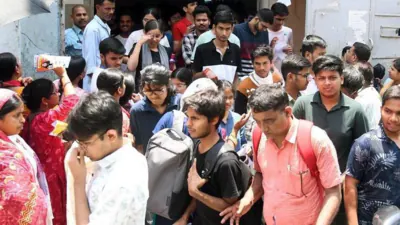
The qualification rate for Scheduled Caste (SC) and Scheduled Tribe (ST) candidates in JEE Advanced 2026 rose sharply by 9.8 and 8.1 percentage points, respectively, from last year, while women recorded their highest qualification rate of 23.4% in the six years covered in the Joint Implementation Committee (JIC) report the Indian Institute of Technology (IIT) Roorkee released on Saturday. It fell by 3.2 percentage points to 39.8% for general category candidates, and for Other Backward Classes-Non-Creamy Layer (OBC-NCL) declined by 0.7 percentage points to 17.5%.
The changes came even though qualifying marks were raised across categories. The CRL is the overall merit list prepared on the basis of candidates’ total marks, irrespective of their category. The changes in qualification rates cannot be attributed to lower cut-offs, particularly since the qualifying marks rose across all categories this year. The JIC report does not attribute the category-wise changes to differences in candidate performance or the composition of the candidate pool. The qualification rate depends on the distribution of marks among candidates and the qualifying threshold fixed for each category. This does not mean every candidate up to that rank secured a seat, as allotment depends on rank, category, choices, programme preferences and seat availability. The JEE Advanced rank is used beyond the IIT system. “Qualifying JEE Advanced is not an entitlement to an IIT seat.
The qualifying pool has always been kept larger than the number of seats so that counselling, category allocations and student choices can be accommodated,” he said. The Common Rank List (CRL) qualifying marks rose to 92 out of 360 from 74 last year, an increase of 18 marks. The general category cut-off or qualifying marks in JEE Advanced rose to 92 from 74. For the OBC-NCL and GEN-EWS, they rose to 82 from 66. The SC and ST cut-off increased to 46 from 37. A 2025 IIT Delhi and the University of Houston study found that the scheme increased the representation of women in traditionally male-dominated engineering branches and boosted the representation of SC/ST women at IITs. Those who participated submitted choices across the 23 IITs and their programmes. The last CRL candidate allotted an IIT seat through the gender-neutral pool had a CRL rank of 28,480. For women in the female-only pool, the last CRL rank allotted an IIT seat was 29,824. IISc Bengaluru, IIM Lucknow, the Indian Institute of Petroleum and Energy (IIPE), Indian Institute of Space Science and Technology (IIST) and Rajiv Gandhi Institute of Petroleum Technology (RGIPT) signed agreements to use JEE Advanced 2026 ranks for undergraduate admissions.
“The qualifying criteria were relaxed to ensure at least twice the number of candidates qualified as compared to available seats in each category,” it says. Rao said that only about one-third of qualifiers secure IIT seats should not automatically mean faster expansion of IIT intake.
