
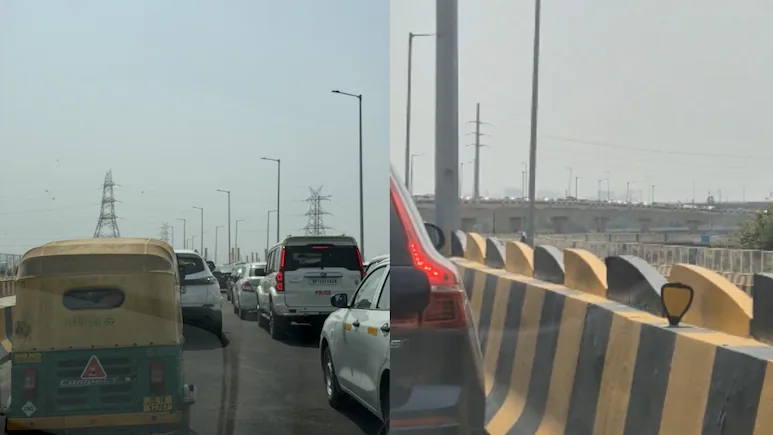
Instead, the stretch has been witnessing heavy traffic during peak hours, and the Delhi Traffic Police has now identified an unusual reason behind the continuing congestion. Delhi’s newly opened Barapullah Phase 3 corridor was supposed to make the commute between East and South Delhi faster. The problem is partly that Google Maps is not reflecting the actual traffic situation on Barapullah Phase 3 towards Barapullah and Ring Road, according to the traffic police.
What Is The Delhi Traffic Police Doing?
This has increased traffic volume and contributed to a bottleneck at Barapullah Junction. The newly opened corridor feeds traffic into the existing Barapullah network, where vehicles eventually converge at key merging points. Traffic personnel have been deployed at the affected points to regulate vehicle movement, as per Delhi Traffic Police’s tweet.
Replying to one of the users, the Delhi Traffic Police made this point: “Width Analysis: – Width of Old Barapullah Flyover (Phase-I & II) = (3 lanes). Width of New Barapullah Flyover Phase-III (Mayur Vihar side) = (3 lanes approx). Width of Sarai Kale Khan side loop = (3 lanes). Width of DND side loop = (3 lanes).”
With the navigation app continuing to show the route as relatively clear, commuters are being directed towards the already congested stretch, the Delhi Traffic police said in a post on X. “This has resulted in heavy traffic volume and a bottleneck at Barapulla Junction, causing congestion to extend for a considerable distance,” the traffic police further said in the tweet. The traffic police has said the bottleneck at Barapulla Junction is worsening as a large number of commuters continue to choose the route.
