
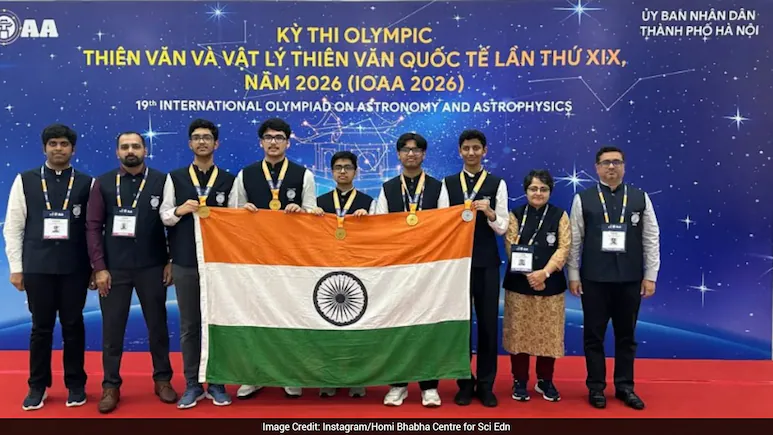
India has put up an impressive performance at the 19th International Olympiad on Astronomy and Astrophysics (IOAA) in Hanoi, Vietnam, with all five members of its team returning with medals.

Pranjal Dixit from Hyderabad, Sumant Gupta from Delhi, Akshat Srivastava from Gurugram and Arnav Sehrawat from Faridabad secured gold medals, while Harshil Amitkumar Patel from Vadodara won silver. Every Indian participant across the International Olympiads in Mathematics, Physics, Chemistry, Biology and Astronomy won either gold or silver this year, according to HBCSE. In the last five years, every Indian participant has won either gold or silver, continuing the country’s strong run in international astronomy and astrophysics.
India finished joint third in the overall medal standings with host country Vietnam. Iran and South Korea topped the table with five gold medals each. The result is particularly significant given the scale of this year’s event. The students were accompanied by Professor Bhaswati Mookerjea of the Tata Institute of Fundamental Research (TIFR), Mumbai, and Professor Sanved Kolekar of the Indian Institute of Astrophysics, Bengaluru. Professor Aniket Sule of the Homi Bhabha Centre for Science Education (HBCSE)-TIFR, who currently serves as the president of IOAA, was also present at the event. The Olympiad tested students on more than just theoretical knowledge. Participants had to apply their understanding of astronomy to observations and scientific data, making the competition a test of both knowledge and practical problem-solving. India’s success in Hanoi also adds to a strong year for its senior science Olympiad teams. India also has a strong track record in astronomy competitions.
The competition, held from September 25 to October 5, saw India win four gold medals and one silver. The 19th IOAA was the biggest edition of the competition so far, with 307 students representing 64 countries. Every member of the Indian contingent managed to win a medal, giving the team a 100 per cent podium finish. Half of the assessment was based on theory, while observation and data analysis each made up 25 per cent. Of the 24 students who competed across these five subjects, 16 won gold and eight took silver. Since it began participating in Astronomy Olympiads in 1999, 49 per cent of Indian participants have won gold, while 35 per cent have earned silver and 13 per cent bronze.
