
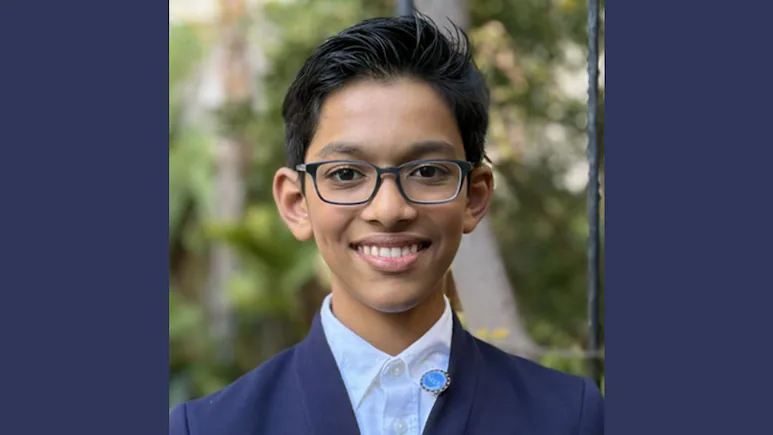
Ankith Burki, a seventh-grade student from California, has been named one of the 30 finalists in the 2026 Thermo Fisher Scientific Junior Innovators Challenge (Thermo Fisher JIC), a leading middle school science, technology, engineering, and mathematics (STEM) research competition in the United States.

Ankith’s project, titled Investigating the Effect of Low-Frequency Sound in Enhancing the Efficiency of Water Generation in Thermoelectric Atmospheric Water Generators, explores how low-frequency sound waves could improve the amount of water produced by atmospheric water generators. Ankith aspires to become an environmental engineer and develop solutions to environmental challenges. “Every year, our Thermo Fisher JIC finalists remind us of what’s possible when curiosity meets courage – even in middle school.
Thermo Fisher JIC 2026 Finals A nationwide panel of scientists, engineers, and educators selected the 30 finalists from this year’s list of the top 300 Junior Innovators, announced earlier this month. This year’s Top 30 are already using science to tackle problems that matter to their communities and the world,” said Maya Ajmera, president and CEO of the Society for Science and executive publisher of Science News.
“Practicing and singing the traditional Indian music that my ancestors have learnt for generations is soothing and helps me connect with my cultural roots,” he said. Reflecting on his motivation, he said he had been fortunate not to face any significant personal hardship but felt a responsibility to create solutions accessible to people with fewer resources and opportunities. He added that a career in environmental engineering would allow him to help create “a healthier, safer, and overall better place for us to live in”. “I am proud to welcome these 30 remarkable young scientists and engineers to Washington this October,” she added.
Atmospheric water generators offer one way to obtain drinking water by extracting moisture from the air. However, their water output remains a challenge. Ankith hypothesised that sound-induced vibrations could help water droplets merge and water vapour cluster, potentially increasing water production. He modified an atmospheric water generator using low-frequency sound to investigate whether the approach could improve its efficiency. Methodology And Results Ankith began by designing his own atmospheric water generator based on the Peltier effect, a process in which an electric current transfers heat from one side of a material to the other. He then conducted four-hour tests under different conditions. The sound-induced vibrations were intended to force water droplets to merge. Passion For Music And Environmental Engineering Beyond scientific research, Ankith is a singer who performs Indian Carnatic classical vocal music.
Project Background Ankith recognises that more than 4 billion people lack adequate access to fresh water and that climate change could further aggravate water scarcity. After several trials, he developed a prototype that could lower the temperature around it by 7.5°C, bringing it below the dew point of the ambient air and allowing moisture to condense and collect as water. Five tests were performed without sound, while 10 others used low-frequency sound waves played through a speaker in two waveforms: sine waves and triangle waves. Ankith measured the amount of water collected under each condition and found that low-frequency sine waves increased water collection by 117 per cent.
A panel of judges will evaluate their scientific research, communication, creativity, and collaboration skills during team challenges. Organised by the Society for Science, the Thermo Fisher JIC aims to encourage young scientists, engineers, and innovators to develop solutions to major challenges facing the future. This year’s finalists are exploring a wide range of topics, including the role of sea urchins in kelp forest recovery, the potential of hydrogels to reduce wildfire risks, alternative treatments for traumatic brain injury, and the influence of language specificity on controversies on social media.
The finalists will participate in Thermo Fisher JIC Finals Week, scheduled for October 23 to 28 in Washington, DC.
