
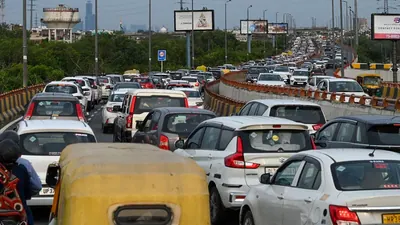
The Delhi Traffic Police has written two letters to the Public Works Department (PWD) seeking a list of major design changes on the newly opened Barapullah Phase-III corridor, which has come under growing criticism after triggering severe traffic jams across south and southeast Delhi.
However, officials aware of the matter said that the letters have been received and a meeting was held on Tuesday with the traffic police and the contractor to discuss steps to ease congestion. The first letter seeks a redesign of the merger point near Sundial Park, where the new elevated corridor joins the existing Barapullah network, citing a sharp road geometry and a mismatch in lane capacity. The second seeks construction of a dedicated U-turn near Gurdwara Bala Sahib for residents of Siddharth Extension, who, in the absence of a designated turn, have been using a ramp in the wrong direction to access the old Barapullah corridor. An aerial drone photograph was attached to the letter to demonstrate the extent of the problem. Phase-III has three lanes, while another three lanes from the Sundial side, carrying traffic from Sarai Kale Khan and Ring Road, merge at the same location. Three more lanes from the Ashram/DND side feed towards the existing Barapullah corridor, which has only two lanes at the relevant stretch. Gupta proposed a U-turn near the gurdwara to provide direct access to the old Barapullah corridor and eliminate wrong-side driving. He also sought a joint site inspection, if required. PWD did not respond to HT’s request for comment on the matter.
Because of the exceptionally high traffic volumes on the newly opened corridor – a crucial stretch connecting Mayur Vihar to south Delhi, it said geometric and traffic-flow issues at the merger were contributing to significant congestion, particularly. As a result, some were taking the wrong-side ramp, creating a dangerous conflict with traffic approaching the old Barapullah flyover. In a letter dated October 1, the deputy commissioner of police (southern range) flagged the issues to the executive engineer of PWD’s flyover project division F-21 after a joint inspection by Traffic Police and PWD officials. In a separate letter to the executive engineer of PWD’s South East Road-I division on October 1, DCP (southern range traffic) Sandeep Gupta sought a dedicated U-turn near Gurdwara Bala Sahib for Siddharth Extension residents travelling towards Lajpat Nagar , INA and AIIMS.
It specifically identified the merger of Phase-III with the existing flyover near Sundial Park as having a “relatively sharp/rectangular geometry instead of a smooth curvature”. “This results in an abrupt merging of traffic and creates a bottleneck at the junction,” it said, attaching an aerial drone photograph of the location. The Traffic Police also flagged what it called a “substantial mismatch” in lane capacity. “Thus, a substantial mismatch in lane capacity occurs, resulting in congestion and slowing down of traffic at the merging point,” the letter said. It asked PWD to make prompt modifications and specifically suggested that the Sundial merger be redesigned with a smooth curvature “to facilitate smooth and safe merging of traffic”. The letter said residents currently have no dedicated U-turn or cut to access the old Barapullah corridor from Ring Road. The problem, the letter said, had increased “many folds” after Phase-III opened, resulting in heavy congestion and a high risk of fatal accidents.
The impact was particularly severe on Thursday evening, when the eight-km drive from Safdarjung Hospital to Sarai Kale Khan took more than an hour. Instead of improving traffic flow, the new elevated corridor quickly became gridlocked, with the congestion cascading across south and southeast Delhi. At the junction where the new corridor met the existing flyover, they found that the merging point had a sharp/rectangular geometry instead of a smooth curvature. The two letters, both seen by HT, underline a growing problem with the newly opened corridor: instead of merely requiring traffic management after opening, sections of the road infrastructure itself are now being sought for redesign by the agency responsible for managing traffic.
The interventions by Delhi Traffic Police come less than a week after Barapullah Phase-III opened to traffic on September 29. As the chaos caused by the new corridor spread, Delhi Traffic Police conducted a drone survey of the new stretch on October 1 and found a set of two three-lane roads were feeding into a single three-lane corridor at several points.
