
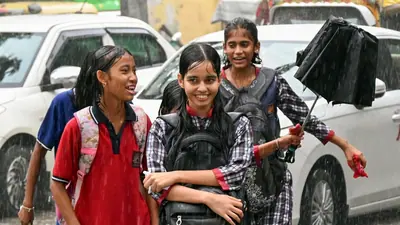
India has made significant progress in closing gender gaps in education, but a stark rural-urban divide continues to leave girls substantially behind boys at the upper-secondary level, with only 59 girls completing school for every 100 boys in rural areas, according to a new UNESCO Global Education Monitoring (GEM) report released in Paris on Friday.
The report also flags the importance of interventions that reduce the direct and indirect costs of schooling. In India, evidence cited by the report shows that free school lunches had nearly twice the effect on primary enrolment for girls as for boys, effectively closing the gender gap in disadvantaged rural communities. Children, particularly girls, who received early and consistent school meal support also recorded lower dropout rates. The report argues that fees are only one part of the cost of keeping children in school. Expenses on books, uniforms, transport, meals and accommodation, as well as the opportunity cost of children’s work, can influence whether girls remain in education. Infrastructure has also mattered. The report cites evidence that India’s national latrine construction initiative increased enrolment among pubescent girls, particularly where sex-specific toilets were provided.
“In rural India, only 59 girls completed upper secondary school for every 100 boys, while there is parity in urban areas,” the report said. More broadly, the report argues that “gender parity does not mean gender equity and inclusion”, since curriculum, pedagogy, teacher attitudes, violence and other factors are not captured by parity indicators. The report says education systems need coordinated measures that address affordability, school meals, proximity, sanitation, safety, counselling, and second-chance pathways, rather than isolated interventions.
