

Imagine a woman preparing to address her community. She uses AI to translate her speech, organise her arguments and explain a policy in accessible language. Yet the same technologies can be used to fabricate her voice, impersonate her or produce sexualised images intended to humiliate her. The opportunity and the threat can sit uncomfortably close together.
Technology helps her reach people previously beyond her audience.
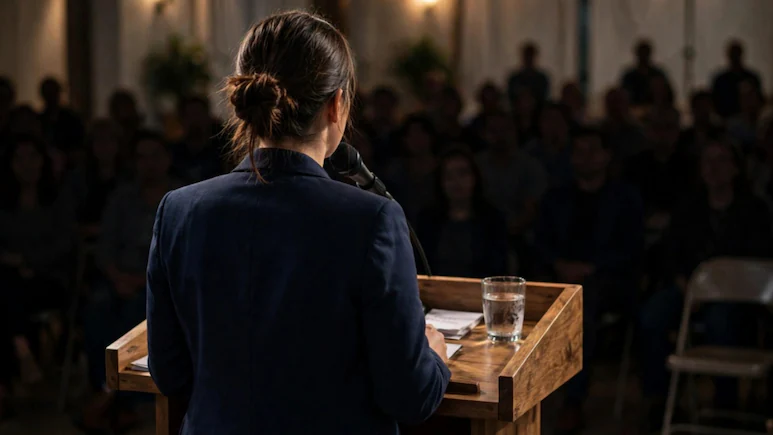
Women should be able to learn, work, organise and speak online without fearing that their visibility will become a weapon against them. Technology has opened new pathways into public and political life, allowing women to speak directly to citizens, build communities and participate in public debate. But access to a microphone is not the same as equality in using it. The question is not only whether women can participate. It is what participation costs them once they become visible. Digital spaces carry the inequalities of the societies that create them. Patriarchal expectations about how women should behave, dress and speak do not disappear when people go online. They acquire new audiences and new instruments. A woman expressing an opinion may find herself judged through her appearance or sexuality while her argument is ignored. Technology can extend familiar forms of social control into every corner of her life. AI introduces additional possibilities for exploitation. Fabricated intimate imagery, impersonation and manipulated recordings can attack a woman’s reputation without any connection to her actual conduct. The violation remains real even when the image is false. Its purpose may be to punish independence, discourage ambition or make public participation unbearable. Asking women to avoid photographs, remain silent or retreat from technology allows those responsible to determine the boundaries of women’s lives. But this is not an argument for shielding women from criticism. Women in public life should expect scrutiny. They should be challenged on their policies, decisions, political judgement, ideology and record. Robust disagreement is essential to democratic life. The harder question is where legitimate political criticism becomes a mechanism for delegitimising a woman through gender. An accusation about a politician’s policy is political speech. Threats, sexualised humiliation and the exposure of private information can impose consequences that go well beyond the immediate insult. They can affect a woman’s reputation, relationships, family and willingness to remain visible. When these expectations are weaponised in political debate, the result can be a form of intimidation that makes participation materially harder. The participation cost we do not always see The most important impact of gendered abuse may not be the comment that is posted or the image that is circulated. It may be what happens afterwards. A woman posts less frequently. She avoids particular subjects. Her team tells her not to engage. She becomes less accessible to citizens. She decides not to contest an election. Another woman watching her experience decides that public life is not for her. When these pressures lead women to withdraw or censor themselves, society loses knowledge, leadership and perspectives essential to democratic decision-making. The woman who leaves public life is visible. That makes this a democratic issue, not simply a technology or platform safety issue. Technology can reduce harm. It cannot change society on its own Technology companies have made meaningful progress in policies, safety tools, reporting mechanisms and proactive detection. AI can help identify and remove harmful content, reduce amplification, protect users from coordinated abuse and provide better avenues for support and recourse. These interventions matter. But removing a degrading comment does not necessarily remove the social norm that made someone feel entitled to post it in the first place. If an AI system quietly removes a sexualised or degrading comment about a woman in public life, we have reduced her exposure to harm. But we should also ask what happens beyond the comment section. What does it say about the political culture around that woman if such attacks are rewarded with attention, laughter or engagement? What happens when supporters amplify them? What happens when political actors condemn abuse only when it is directed at their opponents? This is the difference between content safety and social safety. Platform moderation can reduce exposure to harm. It cannot, by itself, determine what society considers an acceptable way to speak about women. It cannot make political parties condemn abuse committed by their supporters. It cannot stop citizens from rewarding gendered attacks with attention. It cannot change the double standards applied to women and men. We should absolutely make technology better at stopping abuse. But we should not mistake successful content removal for successful culture change. A shared responsibility Technology companies must continue improving proactive detection, enforcement, reporting and support. They should assess foreseeable misuse, strengthen safeguards against non-consensual sexual imagery and provide evidence that helps us understand which interventions actually reduce harm. Political leaders and parties should establish clear standards for candidates, staff and supporters and distinguish consistently between political opposition and gendered personal attacks. A commitment to women’s dignity has little meaning if it applies only when the target is an ally. Citizens and supporters also shape what spreads. Men’s responsibility is particularly important among peers, where silence can be interpreted as approval. Journalists should be careful not to reproduce or amplify gendered attacks in the process of reporting them, particularly fabricated or sexualised material. Civil society can build awareness, research the participation costs women experience and, critically, test interventions that change behaviour rather than simply documenting abuse. Women and their teams need practical support with documenting abuse, securing accounts and obtaining legal and psychosocial assistance. From awareness to action We have become much better at saying: This is a problem. The next step is to ask: What changes it? This means moving from awareness to collective action and testing what works. Can bystander interventions reduce the amplification of gendered abuse? Can political parties establish norms that actually change supporter behaviour? What kinds of support help women remain engaged without placing the burden entirely on them? Which platform interventions reduce not only visible abuse but its downstream effects on participation? Can we measure whether women feel more able to remain visible, accessible and engaged? And what happens when platforms, political actors, civil society and citizens work on the problem together? The Trust and Safety India Festival being convened by Centre for Social Research (CSR) offers an opportunity to bring these questions into practical conversation. CSR’s proposed programme with Meta can provide a starting point for testing approaches that combine digital and AI literacy, support for women in public life and changes in community behaviour. Women should be involved in defining priorities and assessing results. The value of such cooperation should ultimately be judged by what changes in their daily experience. We should measure that change carefully: whether women receive timely assistance, whether repeated attacks are addressed, and whether they feel able to continue speaking, organising and leading. Counting training sessions or removed posts provides only part of the picture. The fuller test is sustained participation with greater autonomy. The right to be heard A woman entering public life should expect scrutiny. She should expect disagreement. She should expect people to challenge her ideas, decisions and politics. What she should not have to accept is that being a woman makes her body, sexuality, family or personal life fair game in ways that her male counterparts do not face. AI and technology can help make public spaces safer. But a safer comment section is not necessarily the same thing as a safer public sphere. If we simply remove the abuse, we may protect the individual from seeing it. If we change the norms that make the abuse acceptable, we begin to change the environment in which women participate. That is a harder task. It requires platforms, political leaders, parties, media, civil society and citizens to take responsibility for the culture we create around women in public life. Creating opportunities for women to enter public life is only half the task. The other half is making sure they can exercise those opportunities freely. The right to be heard must become an everyday reality. ( Ranjana Kumari is Director, Centre for Social Research ) Disclaimer: These are the personal opinions of the author
Because she is a woman is something different, attacking her sexuality, appearance, family or morality. Because the same attack does not necessarily carry the same social cost for women and men, this distinction matters. Because they have watched the cost being imposed on others are not, the women who never enters it.
Bystanders can refuse to share humiliating material, challenge abuse within their networks and support the woman concerned according to her wishes. We must also be careful not to turn “resilience” into an expectation that women simply tolerate more.
Women have historically been judged differently on sexuality, marriage, motherhood, appearance and behaviour.
Its power comes from the social consequences attached to gender. Gendered abuse is therefore not simply abuse that happens to mention gender. Creating safer public spaces therefore requires responsibility across the ecosystem.
