
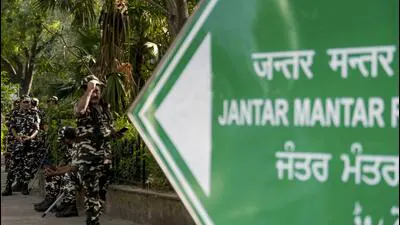
The Supreme Court on Friday called for a rethink of Delhi’s decades-old arrangement of holding demonstrations at Jantar Mantar, recording that the Delhi Police commissioner and other competent authorities would consider designating an alternative venue with better facilities for peaceful protesters.
The court also stressed that any alternative site should have basic amenities, including portable cabins, toilets, drinking water and medical facilities. The court directed the Centre and Delhi Police to reconsider the complete stoppage of public transport, emphasising that preventive security measures must remain proportionate and cannot deprive millions of residents of access to essential services. The Supreme Court’s latest observations revive the question of whether the existing arrangement adequately balances the right to protest with the practical demands of managing large gatherings in the national capital. The protest, called by the Cockroach Janata Party and other groups, seeks the resignation of chief election commissioner Gyanesh Kumar over alleged irregularities in electoral-roll revisions.
The suggestion emerged during the hearing of pleas challenging sweeping restrictions on metro and railway services ahead of the October 10 protests in Delhi. In 2017, the National Green Tribunal ordered a ban on protests along Jantar Mantar Road and directed that demonstrators be shifted to Ramlila Maidan, citing complaints about noise, sanitation and the occupation of public space. The Supreme Court set aside the blanket prohibition in July 2018, holding that peaceful demonstrations could not be prohibited altogether, although they could be regulated to protect residents’ rights and maintain public order. The immediate dispute arose after Delhi Police denied permission for the proposed October 10 demonstration at Jantar Mantar while imposing extensive security measures, including restrictions on metro services and railway movements.
It said a venue must be spacious enough to accommodate demonstrators while allowing emergency services to reach them in the event of an incident. During the hearing, the bench said many of the difficulties surrounding protests arose from Jantar Mantar’s geographical location and suggested that another open space could allow demonstrations to take place with better facilities and fewer logistical complications. “Why don’t you find an alternative space where you can also provide better facilities?” the bench asked solicitor general Tushar Mehta, who appeared for the Centre and Delhi Police. Mehta said he would convey the court’s sentiments to the appropriate authorities.
