
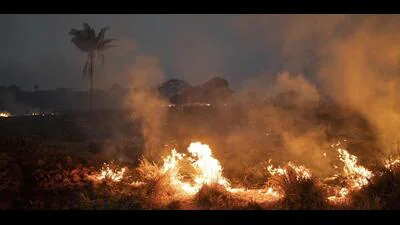
Farm fires, a major reason for pollution in northwestern India and the Delhi-National Capital Region (NCR), have been declining year-on-year. But multiple studies have suggested a trend of farmers setting their fields ablaze after 3pm to evade satellite captures, prompting the government to call for intensified ground-level monitoring.
At a joint review meeting on Tuesday, Union environment minister Bhupender Yadav emphasised the need to intensify ground monitoring and enforcement to prevent stubble burning focussed on fires after 3pm. Air quality in Delhi and NCR starts worsening from mid-September, with stubble burning as a precursor to winter pollution. Smog chokes the Capital every winter. Subsequent fireworks during the festive season, especially around Diwali, worsen the situation despite curbs, which are violated every year. Secondary particulates formed from emissions from transport, industries, power plants, and biomass burning are among the major pollution contributors during winter. He called for special focus on Sangrur, Tarn Taran, Amritsar, Patiala, and Gurdaspur (Punjab), and Kaithal, Karnal, Kurukshetra, Ambala, and Fatehabad (Haryana) to assess crop-harvesting trends. He added that Rajasthan and Madhya Pradesh remained a cause of concern. He asked the two states to identify affected districts and villages and immediately implement a special action plan. Yadav stressed the need to link stubble burning data with that of the Commission for Air Quality Management (CAQM) and the Central Pollution Control Board (CPCB) for effective monitoring. Another Indian Space Research Organisation study noted a similar trend.
He emphasised the importance of providing forecasts of likely harvest times and monitoring meteorological conditions affecting air pollution levels in the NCR so that necessary action can be taken accordingly. PM2.5 is the dominant pollutant affecting the air quality. It added that he called for strict monitoring of stubble burning through ground patrolling and flying squads during the satellite monitoring gap window, when satellites do not capture farm fires after 3 pm. Chouhan cited data from September 15 to October 12 and said there has been a significant reduction of 53.3% in the incidents of stubble-burning in Haryana and around 32% in Uttar Pradesh compared to last year. Environmental think tank International Forum for Environment, Sustainability and Technology’s study in December 2025 found most fires were lit after 3pm, hours when monitoring systems were not working across Punjab and Haryana.
In a statement, Yadav’s ministry said he underlined that monitoring should not rely solely on satellite data and asked district collectors to conduct on-the-ground assessments and strengthen enforcement action to make efforts to curb crop residue burning more effective. Chouhan said there has been a marginal decline in Punjab farm fires in comparison to the same period last year. “We observe a gradual temporal shift between 2021 and 2024, with peak fire activity occurring around 5 PM IST in 2024… At the same time, the window of fire activity narrowed substantially, suggesting an informed adjustment by farmers to avoid detection by polar-orbiting sensors,” said the study published in Current Science in November last year.
