
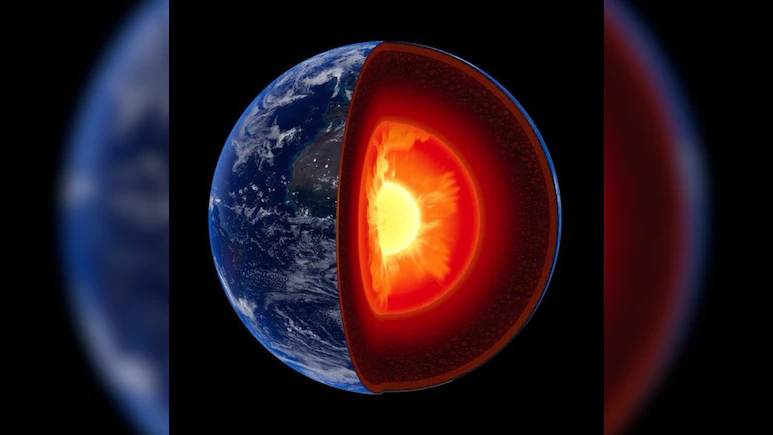
Scientists have found new evidence that Earth’s core may still be releasing hydrogen, helium, and tungsten into the layers above it, challenging the long-held idea that the planet’s deepest regions have remained largely isolated since its formation. A study published in Science Advances by researchers from the University of Science and Technology of China suggests that Earth’s core and mantle have been exchanging materials throughout the planet’s 4.5-billion-year history.
However, the latest research suggests that traces of these ancient materials may still be moving towards the surface. To investigate the process, the researchers used computer simulations enhanced by machine learning to study how hydrogen behaves under the extreme conditions found inside Earth. They examined hydrogen isotopes, particularly the ratio of ordinary hydrogen to deuterium, a heavier form of hydrogen, to understand how the element moves between the core and mantle. Instead, they may reflect an ongoing process that has shaped the planet throughout its evolution. Further research is needed to establish how much material escapes from the core and how this process influences Earth’s long-term evolution.
“Collectively, these results indicate that magma ocean crystallization yields a primitive mantle with an essentially homogeneous hydrogen isotope composition, despite large variations in pressure, temperature, and model assumptions,” the researchers found . The researchers said the findings challenge the idea that the chemical signatures preserved deep within the mantle are simply leftovers from Earth’s earliest stages.
Some of these volcanic rocks have unusually low ratios of deuterium to hydrogen, indicating the possible presence of hydrogen originating from Earth’s early history. The researchers suggest that hydrogen escaping from the core could help explain these patterns. Tungsten offers additional evidence of possible material exchange. During Earth’s early formation, much of this heavy metal became concentrated in the core. Certain tungsten isotope signatures found in volcanic rocks could help scientists trace material moving from the core towards the surface.
