
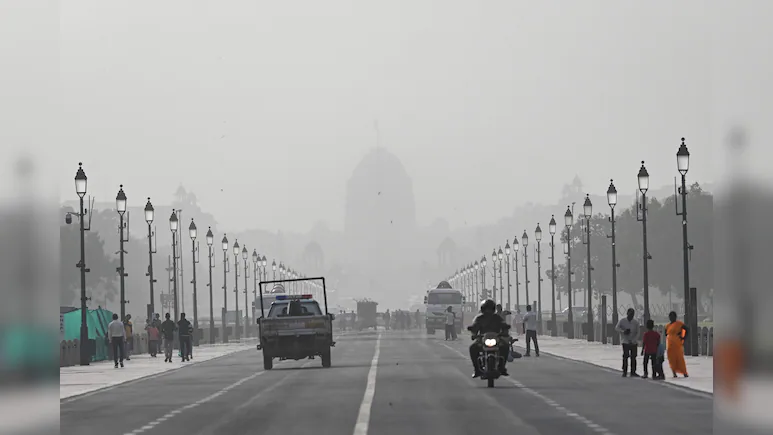
Delhi recorded its lowest minimum temperature of the month so far on Monday morning, with the mercury settling at 17.1 degrees Celsius at the Safdarjung weather station, 1.3 degrees Celsius below the season’s average, the Met office said.
The day’s maximum temperature was recorded at 31.7 degrees Celsius, the India Meteorological Department (IMD) said. Pusa recorded the worst AQI at 281. Earlier reporting noted: At 17.1°C, Delhi records coldest night of October; 1.3°C below normal Delhi recorded its coldest night so far this month on Sunday, with the minimum temperature settling at 17.1 degrees Celsius, 1.3 degrees below the season’s normal, the India Meteorological Department (IMD) said. Earlier reporting noted: The minimum temperature on Sunday was 1.5 degrees Celsius lower than Saturday. Earlier reporting noted: Palam recorded a minimum temperature of 16.9 degrees Celsius, two notches below normal. Lodhi Road and Ayanagar recorded a low of 16.8 degrees Celsius each, also two notches below normal, the IMD said on Monday.
The city’s air quality remained in the “moderate” category, with forecasts indicating a likely deterioration to “poor” levels from October 21, according to the Central Pollution Control Board (CPCB). “The minimum temperature at the Safdarjung weather station, the city’s base station, was 1.3 degrees below normal and marked the coldest night temperature recorded this month so far,” an IMD official said. Delhi’s 24-hour average Air Quality Index (AQI) stood at 139 at 4 pm, placing it in the “moderate” category, according to the CPCB. Of the 58 monitoring stations reporting data on Monday, two recorded “poor” air quality, six were in the “satisfactory” category, while the remaining stations reported “moderate” levels.
No such events were recorded in Haryana or Delhi on Monday. The outlook for the following six days also indicates poor air quality. Unfavourable meteorological conditions could hamper the dispersal of pollutants, the system noted.
A ventilation index below 6,000 square metres per second, coupled with average wind speeds of less than 10 kmph, is considered unfavourable for pollutant dispersion. Meanwhile, satellite data recorded 98 stubble-burning events across six states on October 19, according to the Consortium for Research on Agroecosystem Monitoring and Modelling from Space (CREAMS) laboratory at the ICAR-Indian Agricultural Research Institute. Of these, 27 were detected in Uttar Pradesh, 25 in Punjab, 24 in Rajasthan, 18 in Uttarakhand and four in Madhya Pradesh. Between September 15 and October 19, a total of 1,171 farm-fire events were detected across the six states, including 368 in Punjab, nine in Haryana, 175 in Uttar Pradesh, one in Delhi, 197 in Rajasthan, 51 in Uttarakhand and 370 in Madhya Pradesh. (Except for the headline, this story has not been edited by NDTV staff and is published from a syndicated feed.)
The Air Quality Early Warning System has forecast that Delhi’s air quality will remain in the “moderate” category on October 19 and 20 before deteriorating to “poor” levels on October 21 and 22. An AQI between zero and 50 is classified as “good”, 51 and 100 as “satisfactory”, 101 and 200 as “moderate”, 201 and 300 as “poor”, 301 and 400 as “very poor”, and 401 and 500 as “severe”, according to the CPCB.
