
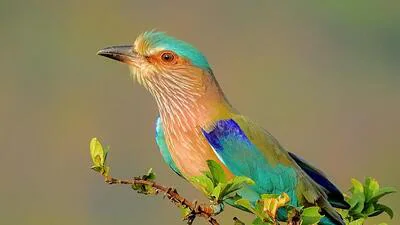
The government has begun the process to carry out a national Red List Assessment of 1,211 bird species across the country according to the International Union for Conservation of Nature (IUCN) framework, with a preliminary assessment already completed for over 100 birds, including the Great Indian Bustard (proposed as critically endangered) and the Indian Roller, whose status has been proposed as ‘vulnerable’, officials said.
India’s National Red List initiative is a collaborative effort, spearheaded by the Union Environment Ministry and is jointly led by the Botanical Survey of India (BSI), Zoological Survey of India (ZSI), IUCN India, and the IUCN SSC Center for Species Survival India–Wildlife Trust of India (CSS India–WTI). The SoIB initiative uses citizen science data to assess population trends for a large number of widespread and common bird species. Population size estimates, however, remain unavailable for the majority of India’s birds currently.
The IUCN Red List of Threatened Species (established in 1964) is the world’s most comprehensive inventory tracking the global extinction risk and conservation status of plants, animals, and fungi. This assessment comes as part of a larger commitment India made at the IUCN World Conservation Congress 2025 in Abu Dhabi, where it launched its ‘National Red List Roadmap’ and Vision 2025–2030, under which it aims to complete an assessment of over 11,000 species of flora, fauna and fungi by 2030.
a final assessment is only expected to be ready towards the end of next year, those aware of the matter said While a preliminary assessment is expected to be completed by the end of this year. “Addressing gaps in these data is therefore essential in strengthening the scientific basis for national assessments,” said WTI in a statement. “To ensure that this national effort is inclusive and scientifically robust, the National Red List Assessment of Birds Forum was launched as a collaborative platform that aims to bridge the knowledge gaps in assessments by bringing together ornithologists and conservationists to share expertise, discuss available evidence, and develop estimates of these key parameters, thereby strengthening the scientific basis for assessing the conservation status of India’s birds,” it added. Aparajita Datta, Executive Director, Nature Conservation Foundation and Co-Chair, IUCN Hornbill Specialist Group said long-term scientific data is essential for understanding changes in bird populations and assessing their conservation status. “The compilation and analysis of large volumes of citizen science data offer an unprecedented opportunity to understand population trends across a wide range of bird species, including those for which systematic monitoring has been limited,” she said.
