
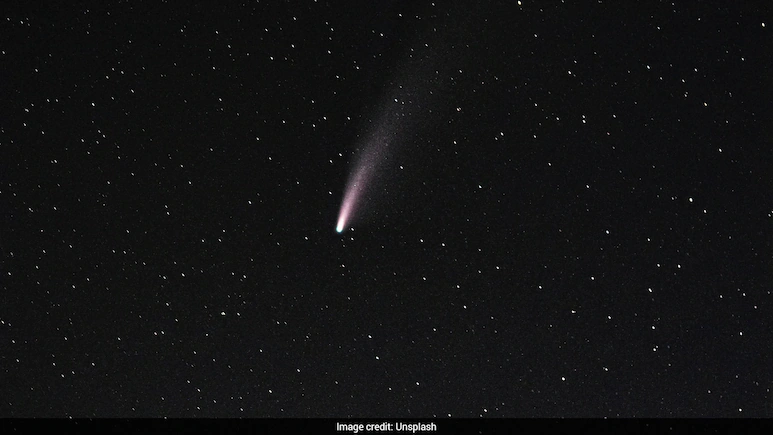
Skywatchers are in for a treat this week as the annual Orionid meteor shower reaches its peak, offering a chance to catch real-life fragments of the famous Halley’s Comet burning up in our atmosphere.
The celestial display happens every October as Earth crosses paths with a massive trail of space dust and debris left behind by Halley’s Comet when it travelled through the inner solar system. When these tiny particles enter our atmosphere at high speeds, they break into fiery streaks of light, commonly known as shooting stars.
However, a bright Moon in the evening sky might make it slightly harder to spot the faintest streaks early on. The experts have suggested that the best viewing window is during the dark, quiet hours just before dawn. Astronomers note that the Orionids are among the fastest and brightest meteors of the year, travelling at roughly 70 kilometres per second. Simply head outside to a dark spot away from bright city lights and let your eyes adjust to the dark for about 20 minutes.
You don’t need any special equipment like a telescope to catch the show, according to Forbes .
Some of the larger fragments can even produce brilliant, long-lasting fireballs. The American Meteor Society states that the Orionids, which are active for several weeks each fall, are active from October 2 through November 7, with activity peaking on October 21-22. The predicted peak in 2026 comes at around 18:00 UTC on October 21, according to EarthSky . In India, the time is 3:30 AM on October 22. Officially designated 1P/Halley, Halley’s Comet is so fascinating that astronomers and scientists want to send a spacecraft to it, as they have designed a trajectory that could launch a spacecraft in the 2030s and rendezvous with Halley in 2060, ahead of its next perihelion in 2061.
The meteor shower is expected to produce around 10-20 “shooting stars” per hour during peak hours, according to Forbes .
